
He Disrupted the UN and USAID. Why Did Trump Spare the IMF and World Bank?
By Ikram Ben Said, Co-Founder of New Visions
Originally published on April 30, 2025
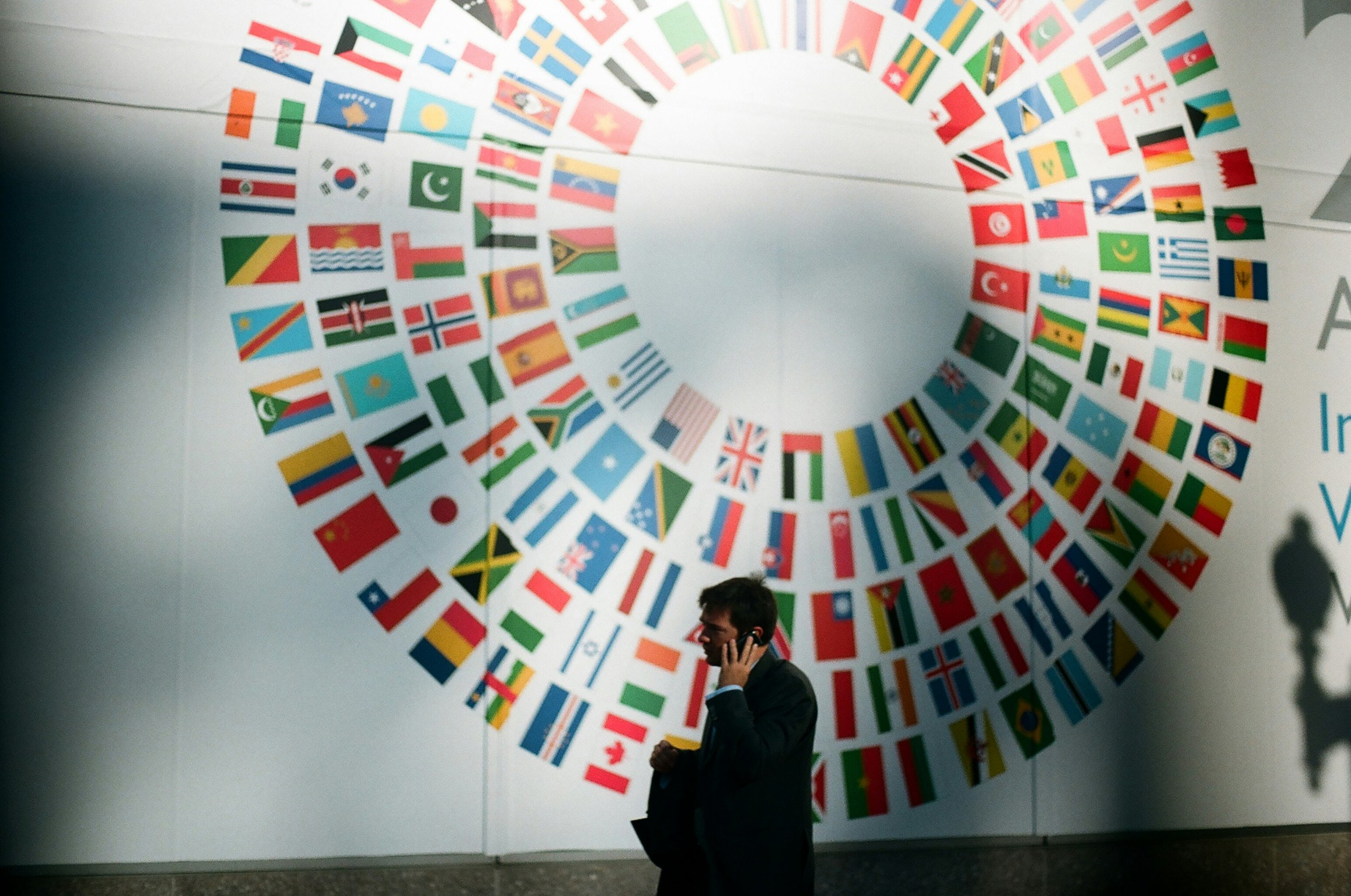
Photo by Markus Krisetya
The 2025 Spring Meetings of the International Monetary Fund and World Bank once again filled the air with promises of "stability," "inclusive growth," and "resilient development." Yet beneath the language of reform, these institutions remain what they have always been: instruments of capitalist domination, enforcing financial hierarchies through debt, austerity, and market liberalization.
This context helps illuminate a political paradox many continue to misunderstand: why, despite his nationalist, anti-globalist rhetoric, Donald Trump did not pull the United States out of the IMF or World Bank.
To understand why, I turn to the frameworks of Noam Chomsky, Éric Toussaint, Naomi Klein, and Nancy Fraser, each of whom, in different ways, exposes how the survival of global capitalism depends on precisely the kind of financial machinery embodied in the IMF and World Bank.
Far from being dispensable, these institutions serve strategic functions that no serious capitalist administration, including Trump’s, could afford to abandon.
Trump’s America First campaign was never a threat to the architecture of empire. As Chomsky reminds us, post-World War II institutions like the IMF and World Bank were designed to stabilize investment climates and protect capital, not to foster democracy or independence . Their function is to create "order" , meaning profitable predictability for capital across a structurally unequal global system.
Éric Toussaint’s work on debt imperialism further clarifies the picture. Loans administered through the IMF and World Bank are rarely neutral financial transactions; they are political weapons. They force debtor nations to privatize public assets, dismantle welfare systems, and subordinate national sovereignty to creditor interests. Exiting these institutions would have meant relinquishing America's most powerful tools for shaping the global South’s economic direction.
Naomi Klein's theory of disaster capitalism shows another layer: global crises, financial, humanitarian, climatic are systematically exploited to push through neoliberal reforms that populations would otherwise resist. Far from discarding the IMF and World Bank, the Trump administration had every strategic incentive to preserve these mechanisms, ready to impose “recovery programs” under the pretext of stability whenever future crises erupted.
Finally, Nancy Fraser’s feminist critique reveals a deeper, often invisible dimension. The austerity measures demanded by these institutions gut systems of social reproduction, public healthcare, education, social safety nets disproportionately burdening women and marginalized communities. Maintaining this architecture means maintaining the unpaid and exploited labor that capitalism relies upon to survive its own contradictions.
In short, Trump’s nationalist rhetoric was perfectly compatible with the realities of global capitalist governance. The IMF and World Bank secure capital flows, discipline debtor states, enforce market rule, and exploit crises vital functions for American supremacy, regardless of who holds the White House. To abandon these institutions would have meant abandoning empire itself.
As Chomsky, Toussaint, Klein, and Fraser collectively teach us: It is not leaders who control capital. It is capital that controls leaders.
The shiny banners of the 2025 Spring Meetings may promise inclusion and reform, but the underlying structure remains intact. Until global economic governance centers social justice, democratic control, and the protection of life over the reproduction of capital, "reform" will remain little more than a managed illusion. As for now one can only wonder how the World Bank and its President, Ajay Banga will resist the anti-climate agenda under Trump, while still preaching their mission "to create a world free of poverty on a livable planet."
Ikram Ben Said
Feminist, Co-Founder of New Visions
