
Hollow Imagination: Politics, La Technique, and the Crisis of Depoliticised Futures
At New Visions, we argue that the crisis of democracy in the Arab world is inseparable from a deeper crisis of imagination, the systematic shrinking of what feels politically possible. Muhammad Alaraby's writing on repoliticizing foresight aligns precisely with what we are building, and this piece grows out of that dialogue. What he offers is both a genealogy and a diagnosis: how futures thinking, born as a project of emancipatory imagination, was gradually hollowed out by corporate logic until it became a tool for managing the status quo rather than challenging it. Reading his argument on hope and the courage to imagine, we kept thinking of Angela Davis and the prison abolition movement, a Black feminist and abolitionist tradition that never asked whether its vision was feasible, never sought permission from existing power structures, and never confused tenacity with naivety. That is the intellectual courage futures thinking needs to recover. At New Visions, we reclaim that the future remains a human project, something we fight for, argue about, imagine together, and build imperfectly. We publish this piece as part of our ongoing commitment to building the intellectual spine that serious democratic futures require.
By Muhammad Alaraby
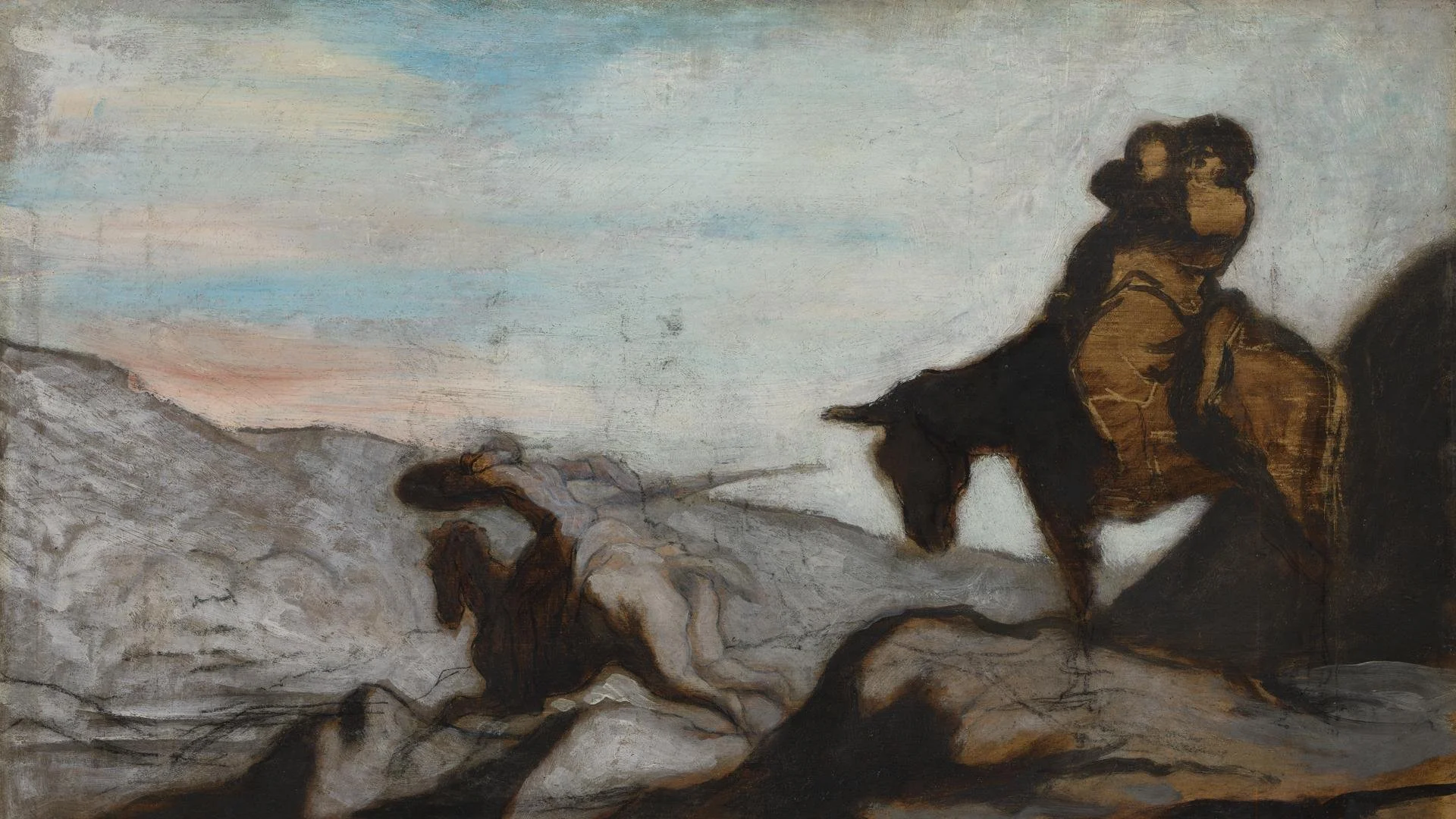
Photo: Don Quixote and Sancho Panza by Honoré-Victorin Daumier, London: The National Gallery.
Futures thinking currently faces a profound crisis: its progressive Depoliticisation. While practitioners often champion a holistic approach to social change, practical applications frequently sidestep substantive political reform in favour of mere technical adjustments. Consequently, the "technical" has come to overshadow the vital political, economic, and social dimensions inherent in frameworks like PESTEC or STEEP or STEEPLE.[1] This narrow focus ensures that proposed transformations rarely transcend incrementalism, ultimately reinforcing the very systems they purport to disrupt. Rather than acting as heralds of transformation, futurists risk becoming unwitting prophets of the status quo.
To reclaim its foundations as a tool for genuine social change, this relatively young discipline requires an intellectual renaissance that returns foresight to its core as a political practice. This essay identifies the primary indicators of this depoliticisation. First, it analyses the shift of futurists into market-driven experts serving corporate and political elites who are necessarily disinterested in systemic change. Second, it explores how the "technical society," as theorised by Jacques Ellul, has reduced complex human struggles to technical puzzles. Then, it will show how a new kind of politics of hope can help us redeem futures thinking to its political and humanist core. To begin, however, we shall define "the political" precisely.
What is the Political?
The omnipresence of politics makes defining its essence a bewildering yet indispensable task for navigating the modern world. While definitions of "the political" vary from Aristotle’s "political animal" to Carl Schmitt’s more adversarial theories, they all fundamentally address how power and order are structured within a society—whether at the local, national, or international level. For the purposes of this discussion, I define politics as the authoritative allocation of values. This process determines the distribution of both intangible goods, such as power and status, and material resources. At its core, it concerns who dominates this allocation, how they maintain control, and the mechanisms through which others can claim their rightful share. Building on this, I highlight contest and struggle—encapsulated in Schmitt’s distinction between friend and enemy—as the irreducible core of political existence.
One must note that this Schmittian sense of politics was tethered to fascist movements in Europe in the 1930s and 1940s, and it might run counter to the logic of emancipating futures as a political practice. However, it resonates in more progressive politics as well. For example, the Belgian theoretician Chantal Mouffe has criticised the liberal sense of politics based on consensus; she has insisted on the ineradicability of conflict. For Mouffe, not every politics is political. While politics refers to the everyday practices, policies, decision-making and discourse, the political refers to the dimension of antagonism that is inherent in human relations and conditions. For her, the political arises from the fact that human societies are always characterised by divisive values, and identities- and by extension interests. Politics is only a channel to this condition.
Every challenge, either stemming from antagonism, conflicting interests or friend-enemy dynamic, we encounter is profoundly oriented toward shaping the future and determining our roles and values within it. Throughout history—from early hunter-gatherer societies to contemporary conflicts in Ukraine and the Middle East—humanity has repeatedly engaged in disputes that, while influenced by the past, focus on realising distinct visions of what lies ahead.
Whether through cooperation or confrontation, political engagement is consistently driven by aspirations for the future. It is no wonder, then, that politics has been the primary force behind every society’s perspective on the "not yet". As Jonathan White indicates in In the Long Run: The Future as a Political Idea, the political landscape has been historically directed and structured by shifting visions of the future—a practice of collective imagination dating back to the Enlightenment.
Futures for a Better Politics
Futures thinking—encompassing futures studies and strategic foresight—originally emerged as a comprehensive effort to foster better politics and societies. During the Enlightenment, intellectuals conceptualised "the future" in its modern sense, seeking to rebuild society through utopias that departed radically from their lived realities. While perhaps naive by contemporary standards, these utopias proved transformative in building new polities. Consider the impact of 17th and 18th-century Enlightenment thought on the American and French Revolutions. These were seismic transitions fuelled by the imagined futures of intellectuals such as John Locke, Thomas Paine, Voltaire, and Rousseau (despite his scepticism of progress), alongside the earlier foundational visions of Sir Thomas More.
Progress, the cornerstone of modernity, was essentially political. To reorder society, politics had to be restructured or even overturned. The possibility of progress carved out a "temporal space"—a future that could be shaped by human agency rather than one deterministically foretold by myth or religion. In this vein, 19th-century ideologies and nationalist movements emerged to "conquer" the future upon the ruins of ancient regimes. While nationalists sought to carve out nation-states embodying land, blood, and the ethos of imagined nations, socialists and Marxists viewed historical progress as a trajectory toward a more equitable and just future.
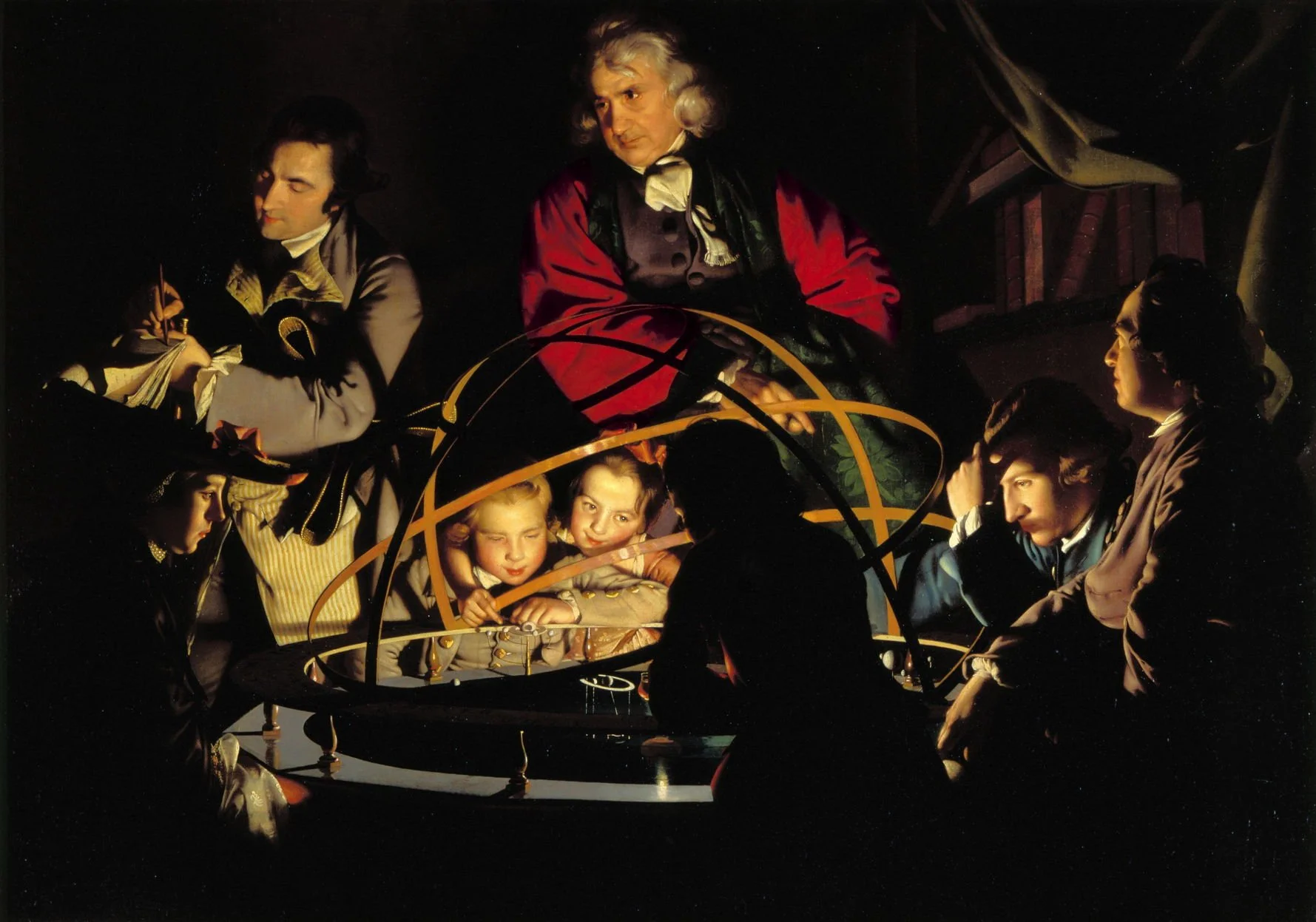
Photo: Joseph Wright’s A Philosopher Lecturing on the Orrery (Wikimedia Commons)
The state became the epicentre of these projects to conquer the future. This struggle to shape what lies ahead was reflected in the global prevalence of the nation-state model. Capturing the state was the primary goal of these ideologies, serving as the instrument to restructure society and organise the market through scientific, planned futures. Following the Russian Revolution, the "Five-Year Plan" emerged as a primary instrument to revolutionise and industrialise Soviet society along Marxist-Leninist lines. Despite staggering human costs, this roadmap succeeded in mobilising millions toward a specific future—one designed by Party bureaucracy and leadership. Politics existed within this framework, yet it was ultimately confiscated by authoritarianism.
Following WWII, futures thinking flourished in the West, particularly in the U.S., where it became systematised into the field of futures studies. However, it emerged largely as a military-industrial project, giving birth to systems analysis and scenario-planning methods developed by the RAND Corporation and pioneers like Herman Kahn. These tools were utilised for strategic Cold War objectives: containment and surviving a potential nuclear exchange with the USSR. This was a "bleak science," imagining outlier scenarios and grounding politics in primordial fear and animosity. For these futurists, the future was determined by techno-militaristic capabilities, reducing the world to a set of statistical variables.
The 1972 publication of the Club of Rome’s Limits to Growth report marked a watershed moment, widening the field's perspective to be more global, ecological, and political. It introduced sustainability as a guiding principle, attempting to create a "choral" foresight that transcended national borders and argued that the future of the "We" depended on planetary constraints.
Though the report faced pushback from both the industrial West and the developing world—both of whom doubted the feasibility of limits—it served as a precursor to the humanist and critical turn in futures thinking. In response to the RAND model's technocracy, scholars such as Eleonora Masini, Jim Dator, Wendell Bell, and Ziauddin Sardar (and later Sohail Inayatullah) began to narrate futures as a project of emancipation. These critical approaches posit that "the future" is a cultural and political construction often manipulated by elites to maintain power dynamics and colonise the imaginations of the marginalised. Innovative tools like Causal Layered Analysis (CLA) and Participatory Foresight were designed to dig beneath the "litany" of trends to uncover the deep myths and metaphors driving society. This movement centred on the "dare to imagine," seeking to restore agency to communities and individuals to articulate "preferred futures" rather than merely accepting "probable" ones.
One of the breakthroughs related to this turn is using futures thinking for cultural critique, particularly from non-Western perspectives. For these cultural futurists, chief among them, Saradar, futures thinking was originally developed not as a neutral forecasting tool, but as an initiative aimed at challenging and deconstructing the intellectual and cultural frameworks that influence human thought. This endeavour was not intended to exclude or to deconstruct the Western/colonial model dominating futures but rather to enrich the field by bringing in more cultural and indigenous cultural perspectives into the discussion on the futures of humanity and to localise futures thinking in the respective cultural context. Reconsidering the traditions of time and space in various cultural Asian, African, Islamic, Arab and Latine contexts is a vital component of this approach to challenge the hegemony of the Western way of the Future.
The Depoliticisation of Futures
The critical discourse of humanist futures, and by extension cultural futures, has been streamlined within most foresight practices over the last three decades. This trend is evident across workshops, conferences, and publications in futures studies and strategic foresight. However, despite being adopted by government agencies, NGOs, academia, and businesses, the field has been largely de-substantiated and depoliticised. This irony can be explained by two primary variables: the prevalence of the corporate business model and the predominance of what Jacques Ellul termed la technique. Both factors have led to a sanitised version of futures that excludes the political core in favour of profitable and efficient outcomes.
Most contemporary futures practices are commissioned by corporations and start-ups that propagate narratives of transformation and promised change. Under this model, futures thinking has evolved into a risk-mitigation business, seeking efficient, adaptive policy options for clients—primarily other corporations or governments. Strategic foresight is thus deployed to tame uncertainty, transforming intellectual consultation into billable hours. Profit, rather than substantive change, dominates the logic of this market. In this context, imagination is valued only when it generates innovation or competitive advantage. To maintain market share, futurists often provide “value-free” options for elites, avoiding sensitive political discussions or advising stakeholders to challenge their fundamental interests. Furthermore, there is an intense focus on branding and rebranding, leading to an expansion of marketed terminology that often refers to the same underlying concepts, simply to ensure a provider’s uniqueness.
This shift has fostered a process of change that emphasises technicalities without substance. This aligns with Ellul’s framing of la technique, which represents more than just technology or “gleaming gadgets”.
"It is the totality of methods rationally arrived at and having absolute efficiency (for a given stage of development) in every field of human activity." —
Jacques Ellul.
La technique is the logic behind the tools—the pursuit of the "one best way" of doing things regardless of ultimate values or social and political goals. Futures thinking has fallen into this trap, where the pursuit of total efficiency has become an end in itself.
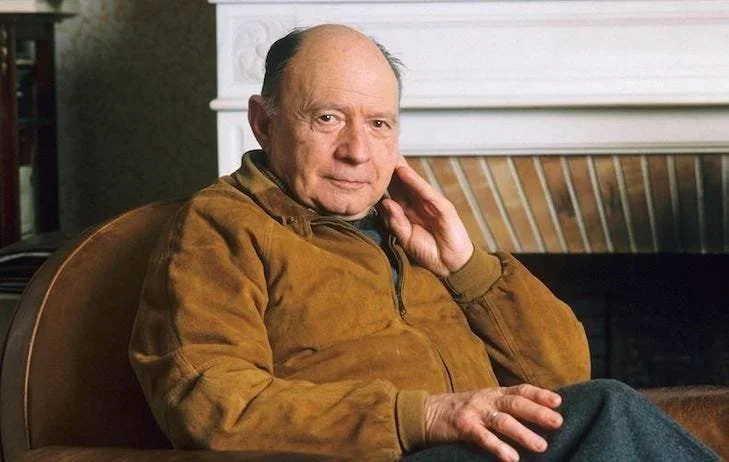
Jacques Ellul, the French philosopher, sociologist, and theologian (1912-1994)
In practice, market-driven futures often follow rigid procedures, such as playing trend cards or filling scenario matrices, without questioning the moral purpose or final goals of the process. Even when using participatory methods, the performance of the activity often overtakes the actual goal of participation. Participants—who supposedly represent diverse societal interests—are frequently treated as mere data providers rather than genuine stakeholders in the decision-making process.
In the technocratic society Ellul diagnosed, real power remains with technocrats and experts who control information flows. They eliminate political choice—the struggle between different values and visions of the "good life"—by proving that there is only one efficient way forward. These experts often act without national commitment or clear value frameworks. Consequently, the role of the futurist has been redefined: they are no longer critics, intellectuals, or political actors, but experts seeking opportunities in competitive markets. Ellul argued that the rise of technocratic power comes at the expense of traditional politicians, though ultimately, neither is in control—only la technique reigns.
Sardar’s evaluation effectively illustrates both aspects of the issue. He contends that the depoliticisation of foresight constitutes more than an administrative alteration; it represents a form of epistemic colonisation. By conceptualising the future predominantly through corporate Prediction and Projection, the Global South is frequently presented with 'used futures'—predefined developmental models that limit local agency. To restore the future as a political process, it is necessary to address this 'epistemic apartheid,' thereby enabling a diversity of civilizational trajectories beyond the exclusive focus on la technique.
The outcome of these dynamics is a foresight practice that is comprehensive but hollow. It can map 500 trends, or more, in a "holistic" PESTEC framework, yet fails to challenge the fundamental political captivities of society. Within the triangle of the state, the market, and society, only the state and the market benefit from this arrangement, as society remains excluded from real power. Therefore, the more transformation futurists preach, the more the status quo remains entrenched.
This depoliticisation is clearly visible in approaches to urban futures and "smart cities". Urban problems—such as splintered urbanism, congestion, crime, and resource management—are framed as "bugs" in an operating system. Solutions focus on introducing technological methods and creating efficient, distant smart cities without addressing the political realities of gentrification, surveillance, and the right to the city. The result is glittering, futuristic urban environments that merely replicate original power dynamics.
In other cases, depoliticised futures practices have been seen as an escapist approach to the wicked problem of the present—or, in Ellulian terms, as propaganda. Consider, for example, how AI is used as a driver for a conflict-free, clean, and well-clothed future that can serve as a panacea for any social problem, from health, housing, and transportation to climate change. It is marketed as a “value-free” tool, suggesting that its outputs are the “one best way” to achieve efficiency. This promised future can be seen not only in advanced Western societies but has also invaded the imagination of policymakers and emerging markets in the developing world, including the Arab world.
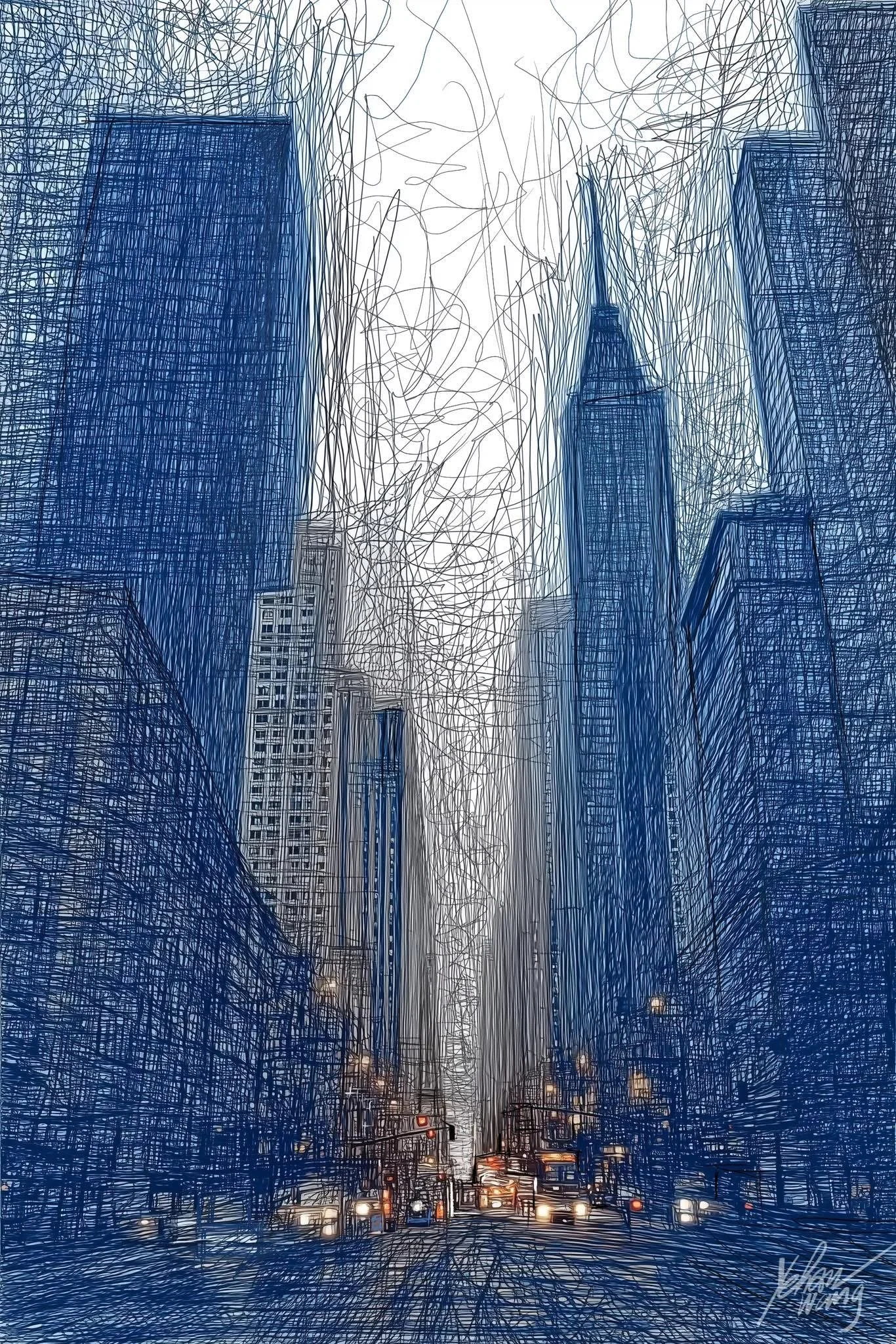
Photo: Uran landscape as a Neural Network by Yehan Wang
A Politics of Hope
To reclaim foresight, we must treat "the future" not as a set of predictable data points, but as a site of political struggle for the dignity of present and future generations. This requires re-injecting the "political" into the discipline—embracing its inherent deficiencies, sufferings, and, crucially, its capacity for hope.
Modern life is currently trapped in a pendulum swing between two sterile moods: a naïve optimism that ignores systemic rot, and a pessimistic doomism that paralyses action. We see this in the desperate aspiration for "final salvation" promised by "end of history" ideologies, or conversely, in a primal fear of total destruction—whether through kinetic war, economic collapse, or a perceived "slavery" to technological overlords.
Both moods are false prophets; neither offers a panacea for our poly-crisis. Instead, we must pivot toward a Politics of Hope. Hope, in this sense, is not "emotional bosh" or a passive dream; it is an active practice of reclaiming and communicating human agency.
A potent antidote to depoliticised foresight is found in the work of Gabriel Marcel. As a Christian existentialist, Marcel developed a framework that directly challenges the modern technocratic impulse to treat human beings as mere "functions" or "problems" to be managed.
Marcel distinguishes hope from optimism with surgical precision. Optimism is the conditional, detached attitude of a spectator. It relies on favourable data; when the data shifts, optimism instantly evaporates into despair. Hope, by contrast, is a "way of being". It is unconditional, flourishing precisely when a situation seems most desperate—in what Marcel calls "captivity" or "trials". It is not a prediction, but a creative response that refuses to accept a dark present as the final word.
Marcel’s most urgent warning for the modern futurist is against the "Spirit of Abstraction". This is the reduction of complex human beings into flattened categories such as "the enemy," "the immigrant," or "the data set".
"There can be no hope that does not constitute itself through a 'we' and for a 'we'." — Gabriel Marcel.
For Marcel, genuine renewal cannot emerge from top-down bureaucratic planning or the isolated individual. It requires communion. In this lived experience, communication is the foundation of our humanity. It is not merely the "exchange of information" (the domain of Ellul’s Technique), but a bridge that transforms "Isolated Individuals" into a "Living Communion".
A politics of hope utilises communication to build communities of practice, localities, and polities. Within these spaces, we reclaim agency without surrendering our individuality to the "snares" of mass propaganda or the fear-triggered algorithms of social media. As Sarah Stein Lubrano notes in Don’t Talk About Politics, the modern refusal to engage in political talk reduces our opponents to "monsters" rather than human subjects.
To break this silence, we need the courage to imagine. This is the highest calling of futures studies: to serve as a systemic method for utilising imagination to generate scenarios and policies that transcend the status quo without falling into "blue-sky" naivety. If we tweak the sentiment of Raymond Williams, we find that in an age of technical determinism, the disciplined use of imagination is a revolutionary act.
Politics is an extension of the human condition—flawed, deficient, and often weak—but it is all too human. To accept it as such necessitates asking the hard questions and enduring the uneasy answers. It requires struggle, sacrifice, and the courage to talk, to test our truths against those of others, and to act. By anchoring our foresight in this practice of hope, we ensure that the future remains a human endeavour rather than a technical byproduct of the market.
Moving Ahead
In our attempt to rebuild an indigenous and localised future in the Arab world, it is necessary to move beyond the “technical society” to highlight the essentially political nature of foresight and political thinking. This is not a theoretical luxury, it is a necessity for a region defined by decades of systemic trauma- from the stalled democratic transformations of the Arab uprisings, and the devastations of civil wars in Syria, Libya, Yemen and Sudan, to the brutal occupation in Palestine. The ensuing frustration and turmoil led to the depletion of political imagination, leaving it trapped in successive crises of repression, violence, extremism and disintegration.
To break this circle, one might argue that futurists need to reject the ‘used futures’ from Western corporate realities. These pre-packaged visions, tailored by market logic and technical mediation, are designed to "tame" our uncertainty rather than transform our reality. Instead of importing efficiency-driven templates, tailored by the global market and technical mediation, we need to connect with realities on the ground, where seeds of transformation are sown. This requires the transition from technical adjustments to everyday struggle, where we can honestly look into what shapes our agenda, the conflicting interests within our communities and polities in regional, national, and urban and rural contexts. It could be a humble start on a minor scale, but it is a move in the direction of decolonising our imagination.
More importantly, this should be based on substantiated politics of hope as a specific practice in our particular contexts. In this regard, hope is not merely a passive dream or fictionalised or rhetorical aspirations; it is a creative response to the current situation in the region. It is a conscious act of recreating communities beyond the ethical, sectarian or partisan loyalties of the past; these new communities should be on lines of shared interests or aspired futures. In these politics of hope, imagination is used in a disciplined way to restore the agency of individuals and social groups and generate scenarios that might transcend the status quo even when the probable ‘future’ is bleak. It is, therefore, a way to endure in the time of trials, insisting that the current turmoil is not the final word for Arab citizenry.
While we are part of a globalised world and cannot ignore its shifting trends, our agency depends on our ability to interrogate the global through the lens of the local. We do not need to "think globally and act locally" in the traditional sense, which often implies localising a global agenda. Instead, we must think politically and act authentically. By anchoring our foresight in this practice of hope, we ensure that the Arab future remains a human endeavour—a site of struggle and dignity—rather than a technical byproduct of a hollow global imagination.
Re-politicising futures thinking in the Arab world is not a methodological adjustment. It is an act of reclamation of time, of imagination, of the right to determine collectively what comes next. The futures we need will not be borrowed, benchmarked, or optimised into existence. They will be struggled for, argued over, and built from within the specific contradictions, histories, and hopes of our own realities. That is not a weakness of our foresight practice. It is its only honest foundation.
Works Cited
Easton, David.The Political System: An Inquiry into the State of Political Science. New York: Knopf, 1953.
Easton, David.A Systems Analysis of Political Life. New York: Wiley, 1965.
Ellul, Jacques.The Technological Society. Translated by John Wilkinson. New York: Vintage Books, 1964.
Inayatullah, Sohail.Questioning the Future: Methods and Tools for Organisational and Societal Transformation. Tamsui: Tamkang University Press, 2007.
Lubrano, Sarah Stein.Don't Talk About Politics: The Communication Crisis in American Life. London: Bloomsbury Academic, 2023.
Marcel, Gabriel.The Philosophy of Existence. Translated by Manya Harari. New York: Philosophical Library, 1949.
Meadows, Donella H., Dennis L. Meadows, Jørgen Randers, and William W. Behrens III.The Limits to Growth: A Report for the Club of Rome's Project on the Predicament of Mankind. New York: Universe Books, 1972.
Mouffe, Chantal.Agonistics: Thinking The World Politically. London: Verso, 2013.
Sardar, Ziauddin. "Colonising the Future: The 'Other' Side of Futures Studies." Futures 25, no. 3 (1993): 179-187.
Sardar, Ziauddin.The Namesake: Rescuing the Future. London: Pluto Press, 2000.
Schmitt, Carl.The Concept of the Political. Translated by George Schwab. Chicago: University of Chicago Press, 2007.
White, Jonathan.In the Long Run: The Future as a Political Idea. Cambridge: Profile Books, 2024.
Williams, Raymond.Resources of Hope: Culture, Democracy, Socialism. Edited by Robin Gable. London: Verso, 1989.
[1] These categories provide a comprehensive lens through which to examine the political, economic, social, technological, ecological, cultural, legal, and ethical drivers of change associated with various futures methods.
Acknowledgments
In writing this piece, I have benefited immensely from the insightful comments and illuminating discussions with my friends and colleagues: Soha Rashed, Noha Shendi, Mark Tirpak and Ikram Ben Said. I am deeply indebted to them for the time they spent reading and correcting this article. My thanks also go to my first and most constant reader—my dear wife, Dina.
Muhammad Alaraby
Award-Winning Arab Futurist I Policy Analyst I Editor