
On Courage, Power, and the Work That Does Not End
A Conversation with Marshall Ganz
Marshall Ganz has spent over sixty years organizing around the same three questions: who are my people, what do they need, and how do we turn the resources we have into the power we need to achieve the change we want. It is a different starting point than most advocacy or policy work, which begins with the issue. Ganz begins with the people.
He left Harvard College a year before graduating to volunteer with the 1964 Mississippi Freedom Summer, at the height of the civil rights movement, found his calling as an organizer, and then spent sixteen years alongside Cesar Chavez organizing California's farm workers. Decades later, he returned to Harvard to deepen his intellectual understanding of that work, eventually earning his PhD and becoming the Rita E. Hauser Senior Lecturer in Leadership, Organizing, and Civil Society at the Harvard Kennedy School, where he has spent over two decades training generations of organizers, civic leaders, and students in the practice of public narrative and grassroots leadership.
His scholarship, most recently his book "People, Power, Change: Organizing for Democratic Renewal," has shaped how movements worldwide understand strategy and power. It was Ganz who helped design the grassroots architecture behind Barack Obama's 2008 campaign, and more recently, he has advised Zohran Mamdani's.
At New Visions, we believe this is a global moment that demands the revival of political imagination. Marshall Ganz has spent his life warning against a version of politics that only knows how to react, that runs from fire to fire. His answer is not urgency. It's power. We sat with him to ask what that actually takes.
New Visions: You started organizing during Freedom Summer and spent sixteen years alongside Cesar Chavez with the United Farm Workers, before you were even thirty. What is the one moment from those years you still think about, the one that taught you something you couldn't have learned any other way?
Marshall Ganz: Actually, there were quite a few such moments, because over the course of those 18 years, there was a great deal of growth, learning, and development. One moment came right at the beginning. We were being trained in Oxford, Ohio, before going to Mississippi. There were about 300 of us at the college, and the next day we were supposed to leave for Mississippi. The day before, we learned that three members of our group had disappeared: Andrew Goodman, Michael Schwerner, and James Chaney. They had been sent a week earlier to investigate the burning of a Black church in Philadelphia, Mississippi, and no one had heard from them since. Bob Moses, the lead organizer, gathered us in a high-school-style auditorium and stood on the stage. He was a very soft-spoken person. He told us, 'We heard what happened to our brothers. We do not know exactly what happened, but we think they are gone.' Two months later, their beaten, bullet-riddled bodies were found buried in a dirt levee.
The Klan had executed them after the county sheriff turned them over. We did not know all of that at the time, but in a sense, we knew. Bob said, 'I wish I could tell you to forget it, that you do not need to go. But we need you to go. I cannot take the whole responsibility. Everyone here has to take responsibility. If you cannot go, that is fine; there is no shame. But this is the time to choose.' The room was utterly silent. I can still picture it. That is when you look inside yourself and ask, 'What the hell am I doing here?' You do not have complete answers. For me, it recalled Germany, antisemitism, and racism, and how my mother taught me that they were connected. She grew up in Virginia and helped me understand those connections. It was also about power. My father was later diagnosed with paranoid schizophrenia, although we did not know that at the time.
He simply was not available to my mother or to me. Yet I was expected to show up, be the rabbi's son, and show up on Friday nights as a dutiful rabbi’s son. It became increasingly oppressive: you are expected to be something you are not because someone else tells you who you are. I was bar mitzvahed, but I brought my non-Jewish girlfriend to the bar mitzvah as a form of protest. I experienced someone trying to define me, and that was what happened in the South every day: 'You do this, boy, because I say so.' That kind of arbitrary power pushed my button. It made me angry, and I wanted to do something about it. It was also a question of courage. My engagement with the civil rights movement never came from feeling sorry for anyone. It came from meeting young people like me who had taken responsibility for fighting. Their courage impressed me, and I wanted to be part of it.
At the first staff meeting I attended with the Student Nonviolent Coordinating Committee, I expected charts, signs, and maps on the walls. Instead, in the sanctuary of a seminary in Atlanta, Georgia, they were holding a 'preach-off' to see who could imitate Dr. King best. In the midst of all that struggle, there was real joy. It reminds me of Surah 94, which teaches that ease can be found through hardship. I wanted to be part of that. When I reached the South, I also realized that this work was consistent with how my mother, who was a teacher, understood education. She explained that the word educator comes from the Latin educare: to draw out, not to put in. You approach a student not in terms of deficit, but in terms of possibility. That was exactly what we were doing, one person at a time, with people who had a great deal to risk.
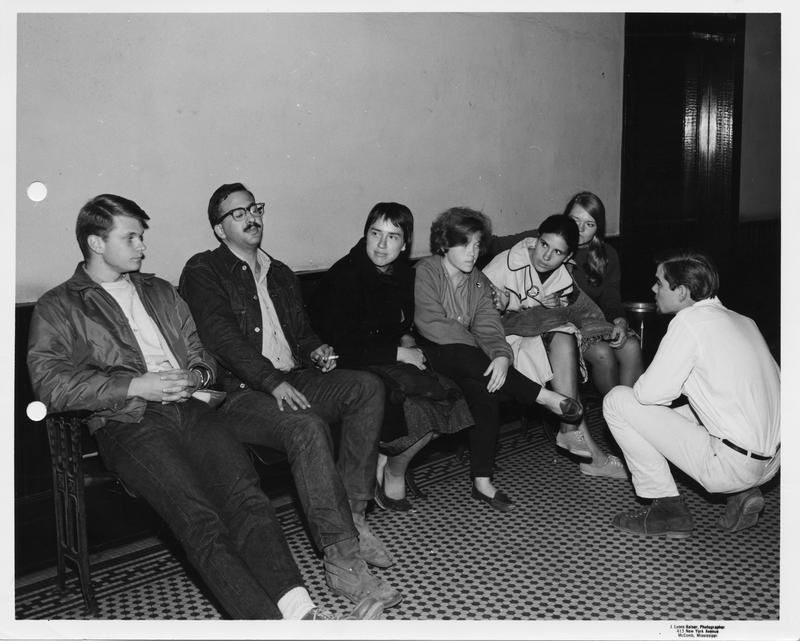
Marshall Ganz and fellow organizers waiting to be booked into jail in Mississippi during Freedom Summer, October 1964. Source: the Mississippi Department of Archives and History, Sovereignty Commission Photograph Collection
Our role was to help them find sources of courage in themselves and in one another, and to use their voices, because without that, nothing would change. The one-on-one dimension of the work - supporting people in finding their own courage - really connected with me. I discovered that I was good at it. That is what kept me in organizing and teaching: the privilege of helping other people grow and learn while finding your own growth and learning in the process.
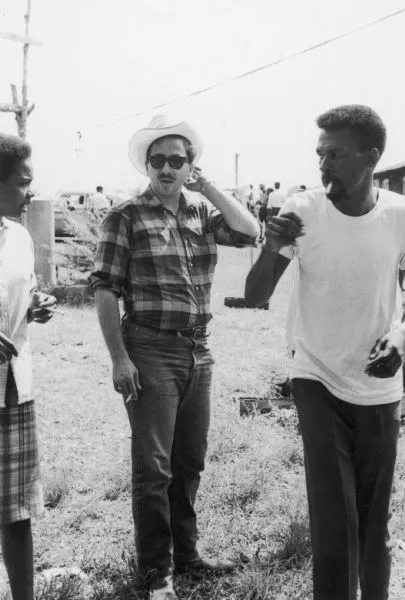
Marshall Ganz at a barbecue for Student Nonviolent Coordinating Committee (SNCC) staff in McComb, Mississippi, 1964. Source: OLD GOATS with Jonathan Alter
New Visions: Marshall, you have spoken quite a bit about courage and about joy. In our conversation with Albie Sachs, joy came up again and again as something central to movements. But I want to stay with courage for a moment, because I think we tend to romanticize it. We imagine fearless people, extraordinary people and in doing so, we miss what courage actually is in the context of organizing. So walk us through it. What do you mean when you talk about courage?
Marshall Ganz: Well, the word itself in English, the root is heart, cor, meaning heart - a strong heart. In other words courage as choosing to take risks. Choosing to take risks that you experience as necessary for living consistently with your values, for what you really care about. In other words, it's the link between the why and the how, in the sense that Yes, I care about this. Okay. Now here. Okay, so now. What's the circumstances right now? What does that mean? I care about this. What does it mean to be consistent? What does it mean to accept the responsibility or the opportunity that confronts me with and it's not like, you know, fearless. It's not fearless at all. That's just not the category. It is about finding the moral resources to act when you know it's risky.
New Visions: Despite the fear?
Marshall Ganz: Yes, yes, despite the fear. But that means you need sources of hope to counter the fear. See, and that's where solidarity matters. That's where a sense of one's own dignity matters. That's where the experience of efficacy matters. Because then you have some lived experience that suggests that could be. That it's enough of a could be that it's worth taking the risk.
See, Gandhi never had hunger strikes. People really misunderstand that. He never went on a hunger strike. He said hunger strikes were a little nutty because you were putting your life in the hands of your opponent. Why would you do that? What he did was fast. And fasts were chosen. A chosen act of sacrifice intended to motivate your own people to sacrifice, and so it's the opposite of a hunger strike.But what it can do, it can generate a lot of power because if people ratchet up their commitment then there is a lot more power to be had, because people will take more risks. So it's more Yeah, I think that's so misunderstood. And so that's courage. You know?
New Visions: Great!
Marshall Ganz: Courage manifests in so many ways. I mean, it turns out to be just so important. And the courage just to speak up.
New Visions:I really like the way you framed courage, acting despite the fear, not in the absence of it. That is exactly what I meant when I said we tend to romanticize it. We imagine people who feel nothing, who are simply stronger than the rest of us. But what you are describing is something far more human: the choice to act in spite of fear, and the search for what you call the moral resources to make that possible.
Marshall Ganz: Just to add to that, when there is no fear, you have sort of given up some of your humanity, because somehow you have lost the value of your own life. That is different. It is not courage, it is something else. Because you have transferred the value of your life entirely to a cause, to the point where you no longer have value except in giving it up. That is very different from taking a conscious risk knowing that you may lose your life if you do X, Y, or Z. I am talking about intentionality. And it is as problematic as thinking you are the whole world. They are extremes. One is seeing only yourself. The other is seeing nothing of yourself at all. And so it's that everything's in that in-between stuff. And that's where I think courage is just so important.
New Visions: You've spent your life teaching people how movements win. Tell us about one that didn't. What did you build that collapsed, and what do you think it costed you, personally, to watch that happen?
Marshall Ganz: One of the things I had to learn is that the biggest failure is not to act. As people say, the only bad question is the one that is not asked. Whenever you act, there is a risk of failure because we cannot predict the future. There are failures at different scales, but fear of failure can paralyze us. It stops us from trying things and from learning. Our culture often treats a mistake as though the earth will open and swallow you, but you have to let go of that idea. Failure is part of the daily texture of organizing. You may hope someone will step up and they do not. A worker may turn on a colleague instead of standing with them. You may plan a tactic and nobody shows up. Through those experiences, you develop judgment, and failure is a crucial part of that development. We expected to win one strike in about a month; it took five years.
The questions then become: what is at stake, who are we with, and can we learn? If failure turns into blame - 'It was your fault,' 'No, it was your fault' - then you are lost because you are no longer learning. You have to accept that things will not always work out. It took us five years to win the grape boycott, so in one sense every year before the victory was a failure. I was responsible for Toronto and for persuading Canadians to stop buying California grapes. I worked in Toronto and Montreal, and it took time to build support and challenge the supermarket chains. That is where the importance of being with others comes in. Feeling alone is very different from feeling that you are part of a group, a community, or a team. You may be responsible for a particular task, but you are surrounded by people who are not judging one another; they are learning with and teaching one another. That makes all the difference.
One of the most important things we teach is how to deal with loss, because you win some and you lose some. If you let a loss consume you and treat it as a prediction of the future, you are finished. But the loss is still painful.
New Visions: Take us back to that moment. How did the young Marshall feel?
Marshall Ganz: I was 37 when that happened, and I had spent 16 years doing that work. What I felt was despair, betrayal, and confusion: what was me, what was the movement, and what was Cesar? When you lose your identity inside a movement, it is risky, because if the movement goes down, you go down with it. Fortunately, several of us went through the experience together. We had a great deal to process in order to recover our own sense of self.
New Visions: How did you find your way through it? I think many activists will want to know the answer to that question. How did you move through and overcome that situation?
Marshall Ganz: Well, first, I wasn't alone. I mean, it's just crucial. Because that's how you know, we're constituted only, I mean, we exist in relationship. And when we allow ourselves to be isolated somewhere, that's bad news, both from terms of accountability, but also in terms of support. And so we were not alone. That was important.
Second was that I think giving yourself time to grieve really matters. You can't just jump right in and say, oh, because you're not dealing, you're hiding it, you're not dealing with it. Grief has to be recognized. It has to be respected. And sometimes it's not intentional, but you have to own the pain and not pretend that it's not there, because it is.
I guess the third thing was you need to be real about the cost that things have when we're so invested in them, and we experience them as personal. So it can be critically important to finding small ways to experiment and learn.
I think it was very important as I had a chance to, for the first time, teach a class in organizing at University of California at Santa Cruz. They were looking for somebody. And the timing was good. And I never taught in a university or whatever, but it was a bunch of lefties in the sociology department. So they said, we're gonna have this thing, the praxis of organizing.
I lived at the time in Pacific Grove, around Monterey, California, my kind of refuge place, because it is right over the mountains from Salinas Valley, where I did so much organizing. So I would drive an hour up to Santa Cruz, and then I had these young people to work with, and I had to figure out how I was going to share what I had been learning, and how I was going to help them learn.Well, that was very resonant with organizing, just in a different context. And so I had a chance to experiment there and just try things. Low stakes, you know? Now, three of those students became major organizers of the Justice for Janitors campaign in Los Angeles, I mean, with the Service Employees Union and all that. And then I discovered, whoa, wait a second. You get to take credit for stuff that you didn't even do. But that was an important experience.
I also did some electoral work that was, for me, low risk. But again, it was about finding ways to work with people differently. Campaigns were mostly marketing by then, though they were not as bad as they are now. My first electoral campaign was with Bobby Kennedy in 1968 in East Los Angeles. What I was taught was this: if you are going to canvass a precinct, you go until you find a person who will take responsibility for the rest of that precinct. You train them, and you move to the next one. In other words, you are developing leadership in the course of what you are doing. It is not an add-on. It is fundamental. That was an important lesson. And that is exactly what Mamdani did in New York. It is not how most campaigns are run, but it introduces a genuinely human and generative element into the work.
New Visions: We will come back to Mamdani. But first, I want to ask you about something that is very close to my heart: women in movements. Organizing traditions, from the Union Farmer Wokers to the civil rights movement, produced iconic male leaders while women often built and held the actual infrastructure, the phone trees, the meetings, the food, the discipline. As someone who has spent decades studying leadership development, why do you think that pattern is so persistent, and what would it take to actually break it?
Marshall Ganz: Well, isn't that the question. It is one of domination going back to the beginnings of our species. This pattern is interesting. We are doing some work on visual arts, and the oldest sculpture we have is the Venus of Willendorf, which is 27,000 years old. There are no male images for a long time. You get to the Greeks and male images appear, but before that, nothing. Somebody used a 3D printer to reproduce it at actual size. The image is all breasts and belly and hair. That is basically what is there. And it turns out it was small enough to hold in your hand. You can imagine her being held during childbirth. The mystery and the magic of birth, of the moon, of periods. I think men were so intimidated by this. Gotta control it! Gotta control it!
Whatever the explanation, I think the domination is fear-motivated. Aggression is usually a mask for fear, not justified fear, but insecurity and doubt. I do not understand this, my God! I have to control it. Now, I am not offering that as some cosmic theory of sexism, but it has been part of our species for a very long time. And so the question becomes: how has that changed? How do we change it? It has been a long struggle. And I think right now the most important struggle in the world is the women's movement. So then you come into these settings and people are saying, we are for freedom and liberation, except that does not include you.
New Visions: Exactly! And my question is really about men in progressive movements. Men who claim to want democracy and social justice. And yet when it comes to women, the message is: sit down, we will do the leading.
Marshall Ganz: Exactly. But you know, the question is why we fear difference. This is a pattern. Now you say, okay, this is a progressive guy. Well, is he progressive in his head? Is he progressive in his heart? Are the values real? Everything gets intellectualized in ideological movements, and so then everybody is progressive.Look at the early Bolshevik movement. Everybody is for freedom, except that does not count for you, because you are of this class and I am of this class. We get trapped by abstractions, and we confuse abstractions with lived experience. Abstractions are just abstractions. They are hypotheses out there in the world. They are not lived experiences. And abstractions take us to categories. You are not this, so you must be that. You do not have the right idea about how property should be owned fifty years from now, so you are out. You are not pure. Those purities come from abstraction.
It's like you don't fit the model. Well, but my mother used to talk about Procrustes, the Greek king who had an island, and he had when he captured prisoners, he'd bring them to his island, and he had this plank of a certain length. And if you were too short for it, you got stretched till you fit. And if you were too long for it, you got chopped until you fit. That's what we do with abstractions. It's what we do with models. It's what we do with labels. It's what we do with categories. And so you don't fit this abstraction that doesn't exist. And so now I'm going to force you to be that. Well, that's about coercive as hell. I mean, there's nothing liberating about that. Quite the opposite. There's really no respect. So I think the challenge is not to take ideology as the same thing as lived experience and reality.
That is why, for me, values are what really matter, because they are what actually moves us. They are what our priorities really are, and they are in the heart. They are feelings. They are not abstractions. They are feelings. And so, how do you lift up the feelings of compassion, the feelings of equality, the feelings of dignity? That is where the action is. It is not a persuasive argument that it should be this way. It comes through modeling it and living it. And yeah, it is tough stuff, but to me, that is what is so encouraging about the women's movement today, globally, because that is happening. I get students from all parts of the world, and that is happening. And an organization like Musawah, I have tremendous respect for them, because boy, they are taking it on. In SNCC, in Mississippi, in the Civil Rights Movement, that threshold had not been crossed. On the other hand, many of the leaders of the women's movement came out of the civil rights movement.
New Visions: Absolutely.
Marshall Ganz: They were sharpened by the contradiction and said, wait a second, that is not what I signed up for. And so they went and built something different. That is how it needs to be, because it is not going to change otherwise. It is a power struggle. And it is a value struggle. And when we shrink from it, or try to do it all in our heads, nothing changes. That is where courage comes in. Now, Fannie Lou Hamer was one of the leaders of the Civil Rights Movement in Mississippi, and a lot of people have never heard of Fannie Lou Hamer.
She was the person testifying at the Democratic Convention on why our delegates should be seated and not the segregated delegates. In fact, she was supposed to speak at our March to Sacramento with the Farm Workers, but it got canceled. There is a classic piece on how in the civil rights movement, the men were the icons, but the women were the leaders at the local level. And boy, that is so true. I saw that in McComb. The local people were the ones who had the courage, often somebody who ran a bar, or a restaurant, or a leader in the church. That was where the real leadership was. Now, on the other hand, there were men like Amzie Moore, like E.W. Steptoe, who I lived with for six months. Very courageous people who made common cause with the young people. It was a cross-generational thing. It was not just young people doing civil rights. There were a lot of dimensions to it. It is a struggle. It is a fight. And women's leadership in the Black community has been important for a long time.
New Visions: You know, I remember something you said in class that has stayed with me ever since and I have repeated it many times. You told us that Rosa Parks's action was no coincidence. She was not just sitting on a bus. She was a trained organizer, prepared for that moment. I have held onto that, because history erases all of that context. We read it as though it were a coincidence, or we romanticize it into something spontaneous. But it was not.
Marshall Ganz: As prepared as anybody could be. She had earned leadership in the community. She earned that leadership by the way she was present to other people and their needs. It was not leadership because somebody said, you are the leader. It was earned. And with that earned leadership she acquired the tools, the partners, and everything needed to take the risk involved, purposefully and with full intentionality. And then going to jail became a sign of honor. Up to that point, it had been, oh God, they must be good for nothing. But then, wait a second. Dr. King writes about that, about learning that going to jail was an honor, it was a privilege. But look, I totally take your point, and I think this is a continual struggle and it has been for some time. Go back and read about Rosa Luxemburg or Emma Goldman, at the turn of the last century, the labor leaders who played crucial roles. We are still fighting this.
New Visions: And the same pattern repeated itself across the Arab world. Women were at the forefront of independence movements, taking real risks, doing real organizing. And then the moment independence was won, they were sent home to raise the kids. The nation had been liberated. Women had not.
Marshall Ganz: And I see it in my students. And it often makes me think of Nabi Musa. What I find so interesting about Moses is that he was of the oppressed but raised in the house of the oppressor. He was a Jew who was an Egyptian. A person of privilege, but also not. That dual identity is what gave him his rage. He killed that man, and so he had to flee. The Jews wanted nothing to do with him because he was challenging the power structure, so he went off into the desert for a long time, found his spouse, found his work, built his life. And then his biggest doubt, when God is telling him he is called to go back: first, I cannot give a speech, I have a speech impediment, I cannot even speak. Second, why will these people accept me? Who am I to them? Who are they to me? They ran me out. And so God has to persuade him: your brother will help, the staff that turns into a snake will help. I will speak through you, do not worry. It is God doing a whole thing with him about yes, you can. And I really love that, because it is so human. With my colleague Bernie Steinberg, we taught a course called Moral Leadership for five years. The first five weeks were all drawn from Exodus, from Moses' challenges: identity, calling, delegation, people versus cause, legacy. They are all there. And Miriam gets written out. Moses' sister, the water giver, who was so crucial.
New Visions: Across the Arab world, a lot of people who want to be active in the public space now choose social entrepreneurship over organizing, sometimes because it's safer, sometimes because they believe more in its results. Isn't that a rational choice, given how dangerous organizing actually is in much of the region? Why should someone choose the riskier path?
Marshall Ganz: I guess the question is, why did anybody resist slavery? You know, why did anybody resist anything? Because it is always - the status quo is always going to resist. And if you're serious about change, then you have to deal with that and of course, it's risky. And of course, you know one of the things when they were trying to fight the union, our organizing, they'd raise wages before we could get there, and say, well, what do you need a union for? Because, in other words, there is always the status quo is always fighting to defend itself, protect itself. You do not make change without risk. And, you know, and there's sacrifice. So I don't know of any movement ever that made any significant change without risk. And, and often it's the people who can least afford it who have to sacrifice the most. I mean, that certainly was true in civil rights and so forth. So, the question is: What is it that I'm really called to do here?
You know, I can certainly rationalize, well, what we saw in Mississippi, one of the things that happened, the poverty program came in, hired a whole bunch of the people that had been movement leaders, paid them bigger salaries than they ever could have gotten otherwise, and the movement died. And that was the total intent. That was a total intent. And, you know, it's kind of like, so it takes a community with deep solidarity and moral foundation and faith, or hope, or willing to call it, to take change seriously. And so I'm just saying that.
New Visions: So what is your critique of social entrepreneurship?
Marshall Ganz: It is just capitalism in a baby form. It started at Harvard Business School as a way to co-opt young people into a capitalist model of change. But it was never about change. It was about using the techniques of private enterprise to produce change, which meant you could not challenge the system. It was all about, oh, a new way to have the water flow. Well, that is fine. That is useful. That is nice. But it did not change the system. There are two questions. One is: how do I get ahead within the system? The other is: how do I change the system? Those are two very different questions.
New Visions: So social entrepreneurship doesn’t deal with power?
Marshall Ganz:No, it accesses power. It tries to get access to it. It does not create it. And that difference is huge. Huge! And it is no accident that young people often play major roles in social movements, because it is about their futures and they do not have the same set of obligations as someone with eight kids. But unless there are people who will take those risks because they care enough, nothing is going to happen. And so the status quo tries to find them and hire them, or capture them into capital dependency, which is what social enterprise is.
And even the model itself — it is the entrepreneur, the individual. But that is not how change works. It is community. It is the opposite of individualism. And I think super individualism is one of the most devastating forces we face, because it is against our whole nature as human beings and as a species. It is an alienation of ourselves from others. It is not engagement with others.
So there is a whole ideology being marketed, and in innocent terms too. When we were at Harvard, we wrote a paper, we did a study on this. The paper, Social Enterprises, Not Social Change, was published in the Stanford Social Innovation Review, and an academic version was also published in academic journals. That was something we really wanted to challenge. And you know the language they start using: product, branding. Oh God, I hate branding. Branding is what you do with cows and slaves. It is not something you do with people. Not free people, not people with dignity. You do not brand. But it is subtle. Now they have AI agents. What? It is a calculating machine. How does it have agency?
New Visions: The USAID shutdown and the broader collapse in development funding has hit civil society hard worldwide. You often point to the Montgomery Bus Boycott, where people organized with almost nothing but their feet. But that boycott lasted 381 days. Most organizations today can't survive 381 days without a grant. Is your model of organizing actually possible anymore for people who need to eat, or is it a privilege of people who already have some cushion?
Marshall Ganz: Well, I do not think there would have been any change if that were the case, because the other side always has more money and can offer the jobs. That is what it is. It is only when systems become so dysfunctional that someone comes along and says, guess what, we need to change. Now there are two pathways when that happens. One is the fascist pathway: this system does not work, it is dysfunctional, so follow me. And it is not even your fault, it is their fault, so let us go hate on them. That is the pathway to the future they offer. That is what Europe chose in the 1930s, not in every country, but that was a choice, and it was a terrible path. The other pathway is to say, yes, this really is dysfunctional, but there are ways we can change it.
And that is where hope comes from. That is what we tried to do with Obama, and that is what any social movement does. If it does not offer hope. And hope is not a promise, it is a possibility. That is all it is and all it can be, because you cannot predict the future. That is where faith comes in, and solidarity. I do not think change has ever been made by the comfortable. That is just not how it works. There may be allies and supporters, but the motivation to change requires some form of hurt. And also hope. Because if there is no hope, nothing happens. The fascists have a chance precisely because the hope they offer, awful as it is, is still a form of hope. We had no salaries for sixteen years. What? My God, these people were crazy. They were all rich. No, we were not rich.
For 16 years. What? My God, these people were crazy. They were all rich. No, we weren't rich.
New Visions: You had no salaries for 16 years?
Marshall Ganz: What we had was a system of subsistence support. Before the grape strike in Delano, there was one staff person, that was Cesar Chavez, and he was being paid $50 a week. Once the strike happened, hey, there is a strike. We do not have any money. So we had to raise food, raise money. We went to the cities, to students, faith groups, and so forth. We had a food store, then we began getting food stamps, then we began paying a dollar a week, then $5 a week. It is kind of a joke, but it was all mutual support. We had health problems. We had doctors who would help. And we built support organizations across the country, in Canada, in New York and Chicago. People knew when they gave money it was going to the cause. It was not like we were buying fancy cars or anything like that. That was a movement, and it was a very demanding one. People do it for a while, and then they cannot, or with families, we negotiate paying certain bills. But that was what it stood on. And it took five years to win the boycott. We developed a whole lot of support communities, all over the place.
Now, could we do that today? I think we absolutely could. When I look at the response to the class we teach on being human, people are starved out there for meaning, for consequence, for dignity, for efficacy. But then the question is: how do you equip that with enough hopefulness and solidarity that it can open pathways to power? South Africa needed allies. The ANC needed the divestment movement, as you know that history. We needed allies in the cities. It is not uncommon for movements to need such allies. But the idea that you can get there in comfort just does not work that way.
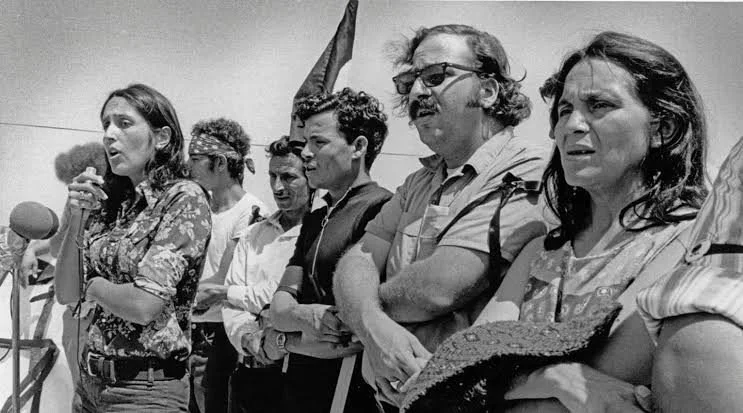
Marshall Ganz in California, c. 1970s. Photo attributed to Bob Fitch; source: LSE Blogs, “Review: People, Power and Change, by Marshall Ganz”
New Visions: I really want to return to the question of money. I recently gave a talk on why we need to center power and power analysis, because without it our methodologies stay neutral, technical, and depoliticized, and lead nowhere near transformation. And the first question from the audience was: how do I pay my rent? It was not the first time someone has framed livelihood and social change as opposites, as if earning a living and fighting for something bigger are mutually exclusive, as if doing both requires selling your soul.Livelihood matters no question about that, but I think we have become so consumed by the smallness of our own lives that we forget how much room remains, in politics, in art, in culture, in community, outside our jobs. I understand that for many people, transformation is difficult to pursue within their professional lives. But outside of work, there are many other spaces.And I am increasingly witnessing something troubling: the moment someone speaks about resistance or change, we are quick to dismiss them as either privileged or as having nothing to lose. So what would you say to that mindset?
Marshall Ganz: Well, I think you've nailed it. I mean, I think this is a way of excusing oneself from taking risks. It confronts a person with the question: what do they really value? It is not surprising that a lot of people, you know, there are certainly people who volunteer while working at the same time. I mean, I just met a whole bunch of them through the Girl Scouts. But I mean, there are certainly people who do that with religious communities and so forth. So that's not strange.
Now, something that requires full-time or nearly full-time commitment, then economics are more of a problem, but it could be in between. But then there's, how can I say, there's choices to be made and I think when they say, oh, they're just so privileged, or oh, they don't give a damn, that is often self-justification. I mean, it's just that is, oh, that's why I'm not doing this. If I had all that privilege, well, of course I would.
Well, no, that's not really the case. And so I think it's important to cut through stuff that is just a smokescreen or gaslighting as opposed to, you know, real concerns. Anytime I have been organizing a union, this is very high risk. You know, people get fired. I mean, you know, you go on strikes, I mean, that's high risk stuff. But it will not happen without people who decide that it's worth it to them to change their conditions to do that. It takes, a lot of leadership, good organizing, and hopefulness, but Yeah, so I just, I cannot think of a progressive movement that avoided this question. I mean, we organized support for the farmworker movement outside, in the places where people bought grapes. Like, I think I was in Toronto and so forth. And the people who were volunteering there tended to be students, union people, church people. Some political people. And not full-time, but taking real responsibility.
And then we had some full-time people who were housed by supporters, and people took us out to eat. You cannot change the world if you are living as though it has already changed. There is a struggle. Like Surah 94, it takes struggle. And it does not change without struggle. But that is not everybody's cup of tea. And it is not helpful to put down people who have made different choices simply to justify your own inaction. But that is often what it is. It is better to say, look, that is fine, just give $5 a month, or just show up one day. Not everybody is going to quit their job and become a full-time organizer. That is just not going to happen.
And it is important to have gradations. We would start with: will you pledge not to eat a grape? Okay. Now, will you pledge to ask other people not to? Okay. Then will you pledge to show up at a supermarket once a week? Now will you take charge of coordinating that supermarket visit? Then would you take charge of coordinating this whole part of town? And then would you quit your job and come work with us full time? These are not value judgments. They are gradations in terms of how much people care and what risks they are able to take. There is never enough money. Never.
New Visions: Great. Let's now talk about the Obama campaign. You built the organizing architecture for Obama's 2008 campaign, and you're now advising Mamdani. But Obama's movement demobilized early in his presidency, and a lot of people who poured years into that campaign felt used and then abandoned once he got to Washington and largely left the economic order untouched. Mamdani is different, he's running an explicitly anti-capitalist, affordability-first politics, not just a better organized version of the same system. So is the disappointment after Obama a story about organizing losing steam once power is won, or is it really a story about organizing without ever challenging capitalism, so the win was structurally hollow from the start?
And what makes you confident Mamdani's fight against capital itself won't get the same treatment once he's the one holding power?
Marshall Ganz: What does it mean to fight against capital? What does that even mean? You know, where? How? From what place? I mean, it's rhetoric. It's not substance. And it's so easy to condemn things rhetorically, you know, and the left is pretty good at that unfortunately, because then it's all about rhetoric and what you call things. It's not what you actually do. I think, so it requires looking at what really happened and what was happening. You know, when Obama ran in 2008. One major point of context is what has happened to American politics: it has become an industry. To the extent that politics is about people talking with other people, it has largely stopped functioning that way. And there are two reasons. One is that the Supreme Court in 1976 said that money is speech. In other words, constraints on campaign spending were thrown out. Okay, that created an almost infinite demand, and an industry grew to meet it.
And the second is that the way the technology has operated is that when you control the technology, then you make a lot of money and that's kind of what you do. And so, it moves more and more away from one person talking to another person. To take a survey, to rely on a poll, to do email, in other words, it becomes increasingly distant from a person actually engaging with another person.
Now, both of those came together in this country, and it's why we have this, I mean, the billions of dollars that's spent on campaigns, it's crazy. Nobody else does that. I mean, social democracies, most of them have constraints, or they have real parties, and we don't have real parties either. So, this is a wild west. And so in that context, when Obama came along and gave that electrifying speech in 2004 and then he decided to run for president,it attracted a lot of hope and a lot of support.
And so there was a high level of motivation. But it wasn't being organized in the way it needed to be, and we were able to contribute a whole lot more about that and so that the energy, enthusiasm, and motivation became better organized and focused with the work that our people were doing. And we won and first in the primary. And, you know, it was, like, up against Hillary Clinton and her extensive advantages. And, I remember in South Carolina, I was working in South Carolina, and, The Black community was not supporting Obama. Why? because they feared either that he would be killed or that he could never be elected. I mean, it was like, this is just a waste. First, he's precious, we don't want to put his life at risk. On the other hand, they would never allow a Black man to win. When he won the Iowa primary, winning in a white state changed people's minds. And that's when something really clicked in the Black community.
They could actually believe that it's possible. And that was really interesting to note. We then won heavily in South Carolina. There is a lot involved in the primaries, and we needed the organization to do that. Now, you have a general election. Now, that's a different ballgame, because in the primaries, you're going state by state, it's much smaller voter turnout. It depends on how much opposition there really is. But when you're in a general election, you know there's going to be a lot of opposition and you can't exactly choose every place. So it's much more contentious. The campaign decided to continue with our approach, but of course it was also supplementing with other sources of funds and so forth. And so then, you know, when we won, it was a big deal for everybody. My experience of it was that Obama's campaign strategy had been to maximize support. The goal was to do everything to motivate, to get people out there.
When he became president, the strategy became, how do I minimize opposition? And so that's quite a shift. And see, I think where many of us, I think, misunderstood Obama was we listened to the rhetoric and not the practice. And so, but once he was in, the biggest challenge this country had faced in a long time was right there, which was the economic crisis. And that was an opportunity to restructure the American economy. And he backed away from it. Now, why he backed away from it, I think number one, he's conflict-averse. He was never good in debates. He's much better at giving speeches. And just as a person, he's not a person that handles conflict well. Second, he did not really understand power very well either. The opposition, they were gonna just do everything they could to kill. Part of his success had been as a mediator, as a conciliator.
I mean, he became the first Black president of the Harvard Law Review, an includer, and knowing kind of how to do that, and he was very skilled at that. But that wasn't the situation anymore.
The opposition was that they were trying to wipe him out. There was reluctance. I think, and misunderstanding about what was really happening. And so you put those two things together, First, he certainly was never the radical he appeared to be. And that was really evident with the economy. I mean, that was really evident. And the other is that simply as a leader, that's not his deal. He was what he was. He's much more of a conciliator, a technocrat, all of that. For others of us, we had built this organization. Now, the problem is that the people didn't own it. In other words, it was a creature of the Obama campaign.
And so it remained there and people were going nuts because they wanted to do stuff, but it was just nothing happening. And so he was able to then put it into the Democratic National Committee and basically put it to sleep. Now, could that have been challenged? Probably, maybe. But the challenge was, how do you challenge this guy who's just been elected president? It was hard. It was hard. There were, and they were very clear about this. In Washington, there were what they called tables. There was a labor reform table, an environment table, an education table, an immigration table. And at those tables were the different organizations and groups that had been fighting for that stuff. Well, so it meant that people were bubbling up. Oh, we can do this for labor, this with this, this with this. He sent Rahm Emanuel, Jim Messina. They went around and met with those groups and they said, look. We appreciate your support.
We can assure you of certain kind of access. But we decide what we're doing, not you. And that's how it works. And so, you know, you want to decide? Okay, good luck. You want to have access? Well, you're going to play ball. That's basically what they did. Well, you know, people were in this place of having very high hopes and plans. How do you challenge the President? The guy's just been elected President. It was very problematic circumstances. There's a very good account of what happened, It is an interview with Chris Edley, who was dean of the Berkeley Law School at the time. And it's very good, was published in The New Republic where he talks about the debate within the administration of what to do about OFA, about the organization. And, you know, some people were, you know, oh yeah, let's do this. But that's not where his head was at. And so, you know, as time went on, those first two years turned out to be a disaster.
Because at the midterm, he lost it. The Republicans took over. And so there was a window of two years in which some really good stuff could have been done. The main achievement was healthcare reform. But it was incomplete. It was a very partial measure. It wasn't really what we needed but it was not healthcare for all but that's where he used all his political capital. Not on dealing with the economy. So, bankers are getting rich again, and people are being thrown out of their houses. You cannot pretend that's not happening. And so, really, after the first two years, it became very hard for him to do much of anything. Because Congress was just determined to stop it on almost everything. Now, he probably could have done more, you know, eventually he gave the executive order on immigration for young people that were born in Mexico but grew up in the United States, called Dreamers. And that was because they weren't afraid to take him on.I mean, when it failed in the Senate, they went to, okay, well, what are you gonna do about it? They were exceptional in their courage to do that. They achieved something. This is an oversimplification, but this is kind of some of what was going on there. And a number of us were basically going crazy. Now, with this campaign, it's a different story.
New Visions: You mean Mamdani campaign?
Marshall Ganz: The Mamdani campaign is a different story. The Obama campaign was always really about Obama. And, you know, we built an organization. Now, if you look at Mamdani, first of all. The campaign is launched by people who are already organized. Democratic Socialists of America (DSA) became a place for people whose values were aligned with it and who wanted to win elections, their values were aligned with DSA, but they also wanted to win elections. And so there was a group formed within DSA, I think it's called the Brooklyn Task Force or Study Group, and that's what they focused on. You know, Mamdani ran for the legislature three times and won before getting elected mayor. And lots of people won and lost. There was a whole lot of shared learning going on based on people who had a basic share in terms of their values. It wasn't the typical campaign operator, it wasn't the typical donor, it was people who cared, people who were, you know, committed. Starting there.
That's a very different place to start. Most political campaigns here, you get the donor, you get the consultant, you get the communication person, you get the candidate who does what he's told to do. Well, this campaign was entirely different, because it came out of a movement, and it was crafted by people who cared, and who were committed to each other. In the Obama campaign, we had to work like hell to get the ground organization legitimate. It was really hard. In Mamdani's campaign, the starting point was the people. How do we build the organization that we need to win? And so it's a whole different thing. So, you're recruiting people to become leaders. You're supporting them in developing their leadership. You organize the campaign in such a way that it's really grounded in human beings and in people in New York. And not, I mean, with real intent and real skill.
You are not dependent on some fat cat donor because the campaign operated at a relatively low cost, with all these volunteers. They had a small staff. They got rid of the pollsters, who had been giving them bad advice and whom they simply stopped listening to, because they had better information themselves about the communities in which they were working. And the pollsters were giving them bad advice, and they didn't pay attention to it, because they had better information themselves about the communities in which they were working. In other words, they were building something with real intentionality that was not going to be like most campaigns. And so when he decided to run, the campaign grew beyond expectations. Nobody thought he could win, including him. I mean, it was like, we're gonna learn from this. Because the established political figures, including Andrew Cuomo, Eric Adams, the mayor, just a total corrupt piece of shit. And then Cuomo, we know who he is So, all right, so let's try it.
When they had their launch, and instead of 120 people, 300 people showed up. Oh, wait a second, something's cooking here! And they recognized the moment. And so then they were able to build on the moment and the people to build a really amazing organization in New York. And in the course of that over 700 people trained in leadership. The 100,000 volunteers, that's where they came from. They also used the media very intelligently. Gandhi once said, never do anything merely for the press, but skillfully open a window on what you are doing for the press. And Cesar Chavez practiced that. There were no conventional press conferences. You want to talk to Cesar, you come to the picket line. You want to talk to Cesar, you come to the general meeting. In other words, it was a contract, in a sense, with journalists to not bullshit them. And it really paid off, because it was something real.
New Visions: Marshall, sorry to interrupt. I just want to make sure I understand the distinction correctly. If I am simplifying it right: the Obama campaign started by building a machine, hiring professional staff and creating an infrastructure. Whereas the Mamdani campaign started with organized people, not a machine. And those people then built the campaign together with him. Is that the distinction?
Marshall Ganz: Well, Organized people.Yeah. Yeah. With him. In other words, he was part of it. And so it never was like, oh my god Mamdani. That came after, and that's from a lot of people that weren't part of the campaign. But it was, and whenever somebody would do that, he would call them on it. I mean, there was this particular thing that somebody was saying, oh, if not for Mamdani, blah, blah. And he interrupted, he said, wait a second, that's not how this works. Says, no, this is your campaign.
He was an excellent candidate and they used the media really well because like their commercials, the videos, he was never alone. He was always doing something with somebody; he was making invitations rather than declamations, and so there was no gaslighting. It was like opening the window on what the campaign was actually doing, but it was true. Most of the social media stuff is the opposite.
It's creating some fantasy that doesn't exist, and trying to project it out there, so it's fundamentally false. And so, when you have the real thing, and you do a good job of sharing the information, well, that was good use of social media, but it was very different than the way it's usually used, because they had the real thing. And having the real thing really makes a big difference. It really does.
They didn't owe all kinds of donors. They had won the right to shape the thing the way they wanted to shape it. Now, you have to be in the real world and what you can and can't do. But the whole approach then to governance has been so different, there's some excellent people brought in, but also the way, for example, Tascha Van Auken, the head of what's he called, the Office of Mass Engagement as part of the city of New York. It is part of the City of New York.
They have organizers, and they're out there working with groups and communities and so forth to help them develop the capacity to secure what they want and need. You don't see that happen much. And then there's the question of did Mamdani own the organization? compared with Obama.
Obama owned the organization. There was no pre-organization or post-organization. Well, this was different. DSA was the foundation for the campaign, and so there was an organization, a democratic organization, that really was the place from which the campaign was launched. And it didn't vanish. In fact, DSA doubled in size, and so there was a mechanism to hold them accountable and to create the tension that you need. Now, sometimes that goes one way, sometimes it goes other ways. But there was an attempt to create a campaign organization that would continue. It would have had to be a membership organization. DSA wasn't happy about that. So what resulted is a much more powerful DSA.
Allied groups, the people that worked with them, all benefited from this. It was not trying to suck all the power into City Hall. It was getting elected with power generated outside City Hall and recognizing that needed to continue. So the wisdom and the depth of commitment and clarity, it's really different. And Mamdani's a very different guy. I have so much more hope for this for those reasons. And the more we interview people, the more we talk in depth, because we're doing this book about the campaign the clearer that becomes. And I am working on an op-ed right now about what was unique about that campaign. Because if you read the articles, people say, oh, they are too left or they are too right. No. What they are missing is the difference between a people-powered campaign and a money-powered campaign. That is the part they do not see, or do not want to see. That is why we are writing this, to challenge that.
It is still tough in the American electoral system. It's a terrible system.
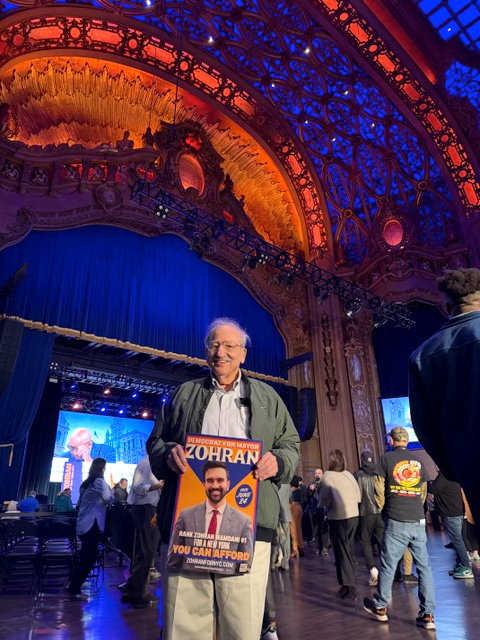
Marshall Ganz at Zohran Mamdani’s victory party, November 4, 2025. Photo courtesy of Marshall Ganz’s personal collection.
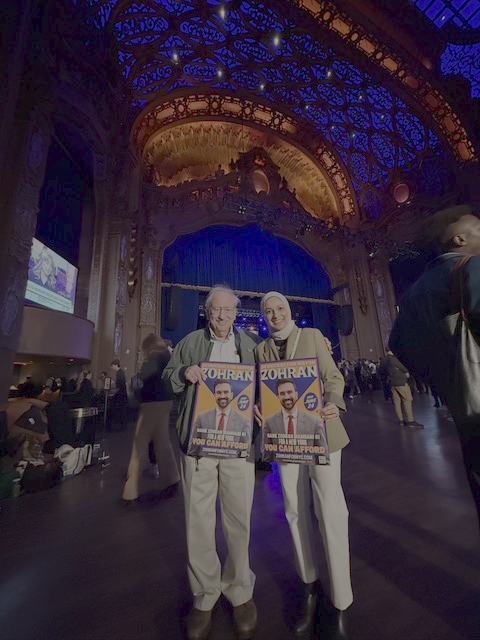
Marshall Ganz at Zohran Mamdani’s victory party, November 4, 2025. Photo courtesy of Marshall Ganz’s personal collection.
New Visions: You say democracy isn't something you have, it's something you do, a practice that erodes without repetition. But people don't just stop practicing democracy by choice. In some places, it's made impossible through repression and through fear. In others, like the US, most people own nothing, take orders all day at work, and have corporations interfering in their private lives long before politics even enters the picture. So when you say democracy is a practice, are you asking something of people who may not have the room left to practice it?
If ordinary people are the ones doing the daily work of keeping democracy alive, often at real personal cost, what responsibility does that put on the people who hold power over them, institutions, funders, governments, employers? What do those people owe in return?
Marshall Ganz: People who hold power do not let go of it. That is kind of how the world works. And so if you are going to shift a power structure, it is going to have to become more costly for them to fight than to concede. You have to become more powerful. It does not change otherwise. And then how do you create institutions that can try to maintain that balance and so forth? It is not easy. There is a good book by the MIT economist Daron Acemoglu called The Narrow Corridor. It shows just how unlikely functioning and sustained democracy has been in the history of the world. Authoritarianism has been around for a long time. In a sense, democracy is something fairly new. At the same time, small groups have often practiced democracy through councils and things like that. So one question to ask people who are fighting for change: are they practicing democracy with each other?
Well, that is a good question, because often they are not. And then you have all the reasons why it needs to be controlled and disciplined, and that can be very true in certain circumstances. But with the Leninist movement, it became an ideology. You did not allow people to self-govern because the party knew best. And so it was the Vanguard Party, which was one very particular idea of socialism. I mention it because people committed to a cause often approach others as being ignorant and needing enlightenment, because if they were truly enlightened, of course they would all be socialists. That is not really how things work. People have to learn, they have to grow, they have to develop. That is why I ask: to what extent are they practicing democracy themselves? What typically happens when a revolution takes power and it's able to take power, and it takes power violently, then guess what? Often what was already happening just happens again. But with a different name.
On the other hand, I went to Nisreen's class a couple of weeks ago. The class she teaches on organizing in Arabic. And I went to her last class, about 80 people. And there are people there from Gaza, from Egypt, from Sudan, from Morocco, from Syria, and they're all working on projects.
You know, and some are education, some are health. In Syria, there's somebody running for Congress. And it was so hopeful to be able to say, under these circumstances, look at this. Look at these people. So that's where you get the inspiration. Who knows what will come out of that? We don't know. But you're cultivating the soil, you're creating the capacity, you're developing the leadership and the people, their own confidence. You're not just substituting one authoritarianism for another one. Because that doesn't change much. You just create, you just shift the dependency. So that's kind of so what I mean by that now in this country. Everybody says it's a democracy. Well. The number of self-governing organizations, in other words, where it's an organization and its members pay for it and they elect their leaders, well, the Girl Scouts is that there are some unions that actually function that way. But many other organizations have been turned into NGOs, and they do not practice democracy, quite the opposite.
They have these wealthy funders. They decide what's gonna happen. People work for them. They're a nonprofit firm. But they're a firm, they're not a people's, they're not a democratic organization. And so they're not practicing democracy, they're providing services and all that. So the question of how do people learn democracy? Well, you learn by doing it. And if you're not doing it, well, then how are you supposed to know even what it is? It's just a word. And if that word is not something you actually experience, and it is not associated with making real gains for you in your life, then that is the problem. Everyone says, 'You have to protect democracy,' but for most people, that does not mean anything. That's not part of their lived experience. After World War II, it was part of people's lived experience, and you can go back and listen to songs and so forth about democracy in 1946, '47. Well, yeah, it was in contrast with fascism.
That is what I mean. It is something you do, and you find ways to do it.
New Visions: So following your cultivating the soil mindset, Marshall- if a civil society organization truly wants to promote and defend democracy, does that mean it must itself become a membership-based organization?
Marshall Ganz: Well, as much as they can. Not every organization can do that. In other words, you may have a training institute, right? And the training institute doesn't claim to be representative. Okay, we are providing training. This is our expertise. But if you claim to represent anybody, you must genuinely represent them. You may say, you know, now you have a mailing list. Oh, that's who we represent. Well, no, it's not real. And so, if you claim to represent anybody, you better represent them. And that means practice. Otherwise, it becomes rhetoric. It was very meaningful to be at the Girl Scouts convention, to hear participants say, 'I move this,' or 'I object to that,' while making decisions about policy and young women and girls, and it was really cool. It is not glamorous, but it was really cool, because it was real. And they were actually learning how to exercise citizenship in a participatory way. Now, you know. Democracy is difficult to build.
You know, when somebody tries to impose it from the outside, which the U.S repeatedly attempted, failing, because it wasn't really about democracy, it was about control. The aim was to set up a system that could be controlled from the outside. It wasn't really about, oh, we want these people to govern themselves. That was the rhetoric. So, you know, it's not an easy thing. New and unexpected possibilities can still emerge. India now has the Cockroach Janta Party, which is really good. You know about the cockroaches?
New Visions The one started by young people in India, if I remember correctly, that began as online satire in response to a judge who called unemployed youth "cockroaches" and then grew into something much larger?
Marshall Ganz: Yeah, the cockroach movement. See, that's wonderful. There is energy there, there's young people, there's a future, and so, you know, supporting that, whatever, making wisdom available is really important. That is the kind of energy worth supporting.
New Visions: Marshall, thank you. This was truly illuminating, and I am certain our readers will find it as rich and generative as I did. I hope you enjoyed the conversation as much as I did.
Marshall Ganz: Very much. Look, I love this kind of conversation, because the questions are real, and the learning is real, and so I get to give my very long answers to short questions, but that is part of the exchange.
New Visions: And that is precisely the point. This conversation was never just about Marshall Ganz and what he did or did not do. It was about what all of it tells us, about democracy, about organizing, about what it actually takes to build power and sustain it. Learning is the thing. So Thank you.
Marshall Ganz: Well, and it's just as much learning for me, and I'm not kidding. I mean, it's real, because it is a conversation with the future. I mean, your circumstances are different from those of the past. Okay, how do we deal with that? That is what makes this generative for me.
End Of The Conversation
