
Does Political Imagination Survive Power?
A Conversation on Futures, Long-Term Thinking and Public Institutions
New Visions works from a central thesis: that political imagination: the capacity to envision and demand genuinely different futures, is one of the most contested and suppressed resources in political life today. Our work has largely focused on civil society, on the opposition, on those who imagine from outside power. This conversation turns that lens around.
What happens to radical imagination when it enters institutions? What does power do to those who arrive carrying a vision of change? And what can two ministers, from two different democracies, two different continents, two different historical moments, teach us about the relationship between imagination, governance, and the futures that institutions allow or foreclose?
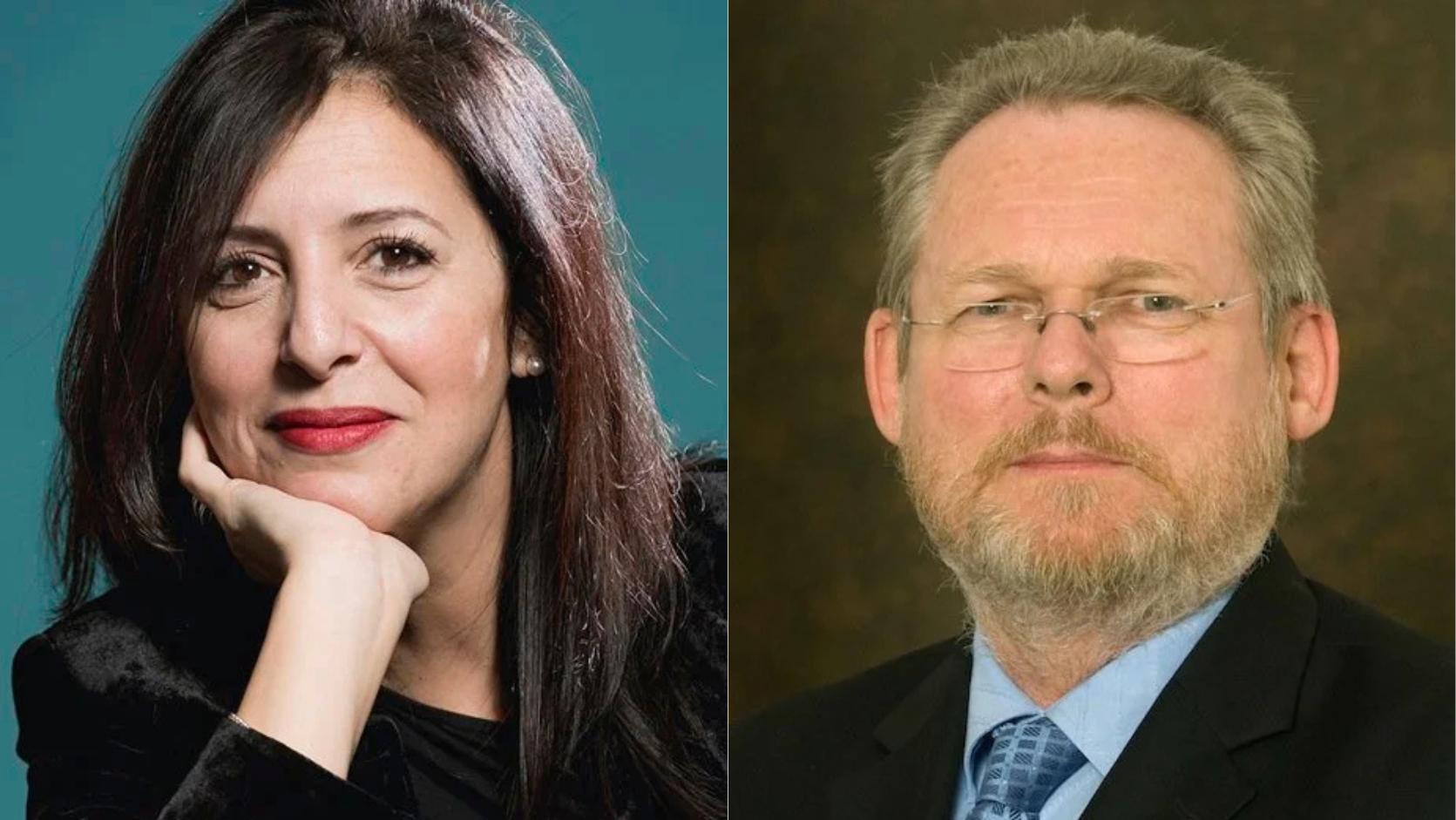
Rob Davies and Zakia Khattabi are not ordinary ministers. They came from movements, carrying not only their own dreams but the hopes and promises of thousands of people behind them. Rob Davies, anti-apartheid activist and freedom fighter in the South African liberation movement, who lived in exile, arrived in government as someone who had sacrificed years of his life for the possibility of a different South Africa. Zakia Khattabi, daughter of a Moroccan immigrant and lifelong feminist and politician, arrived carrying the weight of those who had never been inside the room before.
What happens to people like that when they enter power? What survives, what gets lost, and what does that tell us about the futures that institutions are willing, or able, to build?
This is a published transcript of a recorded conversation conducted by Ikram Ben Said, President of New Visions, with Zakia Khattabi, former Minister of Climate and co-president of the Green Party in Belgium, and Rob Davies, former Minister of Trade and Industry of South Africa. Two ministers who between them held some of the most consequential portfolios of their respective governments: climate policy in Belgium and trade and industrial strategy in post-apartheid South Africa.
Zakia and Rob are also Board members of New Visions.
The transcript is published in their own words, without editorial mediation or analytical overlay. What you read is what was said. At a time when political figures are increasingly managed, curated, and communications-trained into safety, we chose to do something different: Trust the reader with the unmediated complexity of two political lives.
June 2026
Question 1 - New Visions: Democratic governance is structurally built for the short term : election cycles, fiscal years, media pressure, donor timelines. Did you ever find a way to protect genuinely long-term thinking inside the government? Or is anticipatory governance, honest long-term thinking about futures, simply incompatible with how democratic institutions currently function?
Rob Davies: The liberation movement was deeply concerned about economic policy and the economic challenges. One area of critical importance was the recognition that Africa's underdevelopment was rooted in the fact that colonialism had relegated us to the role of producers and exporters of raw materials, used in production processes outside the continent — and that in value chains, the raw material product was actually the smallest to be in, as well as one subject to cyclical trends.
I was quite an observer and reader of what's called heterodox developmental literature, and came in with a strong view that what we needed was the pursuit of industrial policy and industrial development. There had been efforts at industrial policy in South Africa, but in the 1994 period, when we came into office at the first democratic elections, we were at the high point of a particular economic orthodoxy. Policy initiatives in South Africa after 1994 tended not to call themselves that. So I came in with political acceptance from our government that we could pursue industrial policy.
We never achieved the coordination of macroeconomic policy objectives to industrial policy that was necessary. Our efforts were really too little to make the fundamental impact, but I think we did demonstrate the importance and significance of this.
And with that has also been the respect and support for democratic governments. There are quite a few polls being conducted on the African continent where people are asked about democracy — and the reputation of what has passed as democracy is not seen as anything which has sufficiently served the needs and interests of the people of our countries and our continent.
New Visions: Well, thank you Rob. Let's move to Zakia — with a democracy probably with less structural constraint, as you said. Go ahead, Zakia.
Zakia Khattabi: I'll try to come with some added elements to what we've just heard from Rob. Well, I don't believe democracy, by nature, is incompatible with long-term thinking. I believe neoliberal democracies have been organised in ways that make long-term thinking extremely difficult. And one of the reasons is not only the dominance of market logic and economic short-termism, but also the electoral structure itself.
Political parties are constantly looking toward the next election cycle, and many decisions are therefore evaluated not according to their long-term social or ecological benefit, but according to the immediate electoral cost. Governments become trapped in a permanent campaign logic. And we see this very clearly with climate policies — I've been in charge of climate policies, and we see it very clearly — because the benefits of ecological transition are often visible only in the medium or long ter whereas the ‘costs’ and constraints can be immediate and tangible for citizens. Even if moré and more, people rarely experience the disasters that were avoided directly because of a climate policy. What they experience immediately are changes in prices, habits, mobility, or consumption. As a result, political leaders often hesitate to adopt ambitious measures because they fear electoral backlash before the positive effects can materialise.
There is a structural mismatch, if I may call it that, between democratic timelines as they currently function and the temporal reality of ecological transformation. This creates a profound tension: the policies that are most necessary for the future are sometimes those that are least rewarding politically in the present.
In systems increasingly shaped by media acceleration and political polarisation, parties often focus more on surviving the next election than on preparing society for the next generation. The challenge becomes: how do we create democratic structures capable of protecting long-term collective interest from the pressures of permanent immediacy? Sometimes that means embedding long-term objectives into law — that's what I've tried to do with the climate law. And sometimes it means building institutions with continuity beyond electoral turnover.
I believe much more in our institutions than in our governments, because institutions stay in charge when you see governments going one after another. It's something I say with a lot of precaution — but it is also because I've been in charge that I see that what helps us, or what saves us, is more our institutions than our governance, in the idea of medium and long-term visions.
New Visions: So Zakia, you mean public institutions held by public officials rather than elected officials?
Zakia Khattabi: Yeah, absolutely. What I mean is that whilst politicians come and go, government departments remain in place, and despite changes in political direction, they can ensure a degree of continuity in the medium and long term.
I saw it with my own administration. Just before me, there was a liberal minister in charge of climate. I'm a green one, so you see the difference and the gap between our visions. You see the tension for the administration coming from a right-wing minister to a green one — they also have their own guidelines, despite the politicians, which in my case was a good thing.
Another and last element: sometimes it means creating social coalitions strong enough that abandoning ecological commitments becomes politically costly.
Well, as a conclusion here, I do not believe the answer is less democracy. The answer is deeper democracy — one capable of reconnecting political decision-making with historical time, ecological reality, and intergenerational responsibility. I'll go further with the question on civil society and the link between politics and civil society. For this question, I'll end here.
New Visions: Thank you, Zakia. Before we move to the second question, Rob, do you have a quick comment on Zakia’s response?
Rob Davies: I just want to say — I actually agree with that. I hope what I was saying earlier wasn't interpreted as me being in favour of a non-democratic developmental path. I think we should be able to develop a developmental path within a democratic framework.
The distortions brought into democratic governance by neoliberalism have been profound and have shaped short-termism. And even before Donald Trump, there was no international funding at the scale we needed. Now there's even less.
Zakia Khattabi: Something here, Rob, about our public debate — civil society has come forward with the idea of a permanent citizens' assembly, which would have the responsibility of discussing and debating long-term issues. The idea — and we're still far from it — is that you have the parliament working on short-term issues and alongside parliament, a permanent citizens’ assembly that focuses on the long term
Question 2 - New Visions: We will go back to the question of constituency — we have a question about that. But first let me move to the second question, which is around political imagination.Political imagination — the capacity to understand power and to envision genuinely different futures — is what brought you into politics. What does the institution do to that capacity over time? Does power expand imagination or quietly amputate it?
Zakia Khattabi: Power can expand imagination in one sense. You suddenly understand the architecture of society more concretely — of social organisation or political organisation. You see where decisions are actually made. You see hidden veto points. You see how power circulates through finance, bureaucracy, diplomacy, media. And that knowledge matters.
But institutions also normalise limitations. The danger is not corruption in the cinematic sense. The real danger is adaptation. You slowly internalise the borders of the reasonable. You stop proposing certain things not because they are impossible, but because you anticipate resistance before even articulating them.
That's why movements outside institutions remain essential. They protect the political imagination from administrative domestication. They remind governments that realism is often just another name for the current balance of power. The task is not to choose between movements and institutions — it is to maintain a living tension between them. Without institutions, imagination remains symbolic. But without imagination, institutions become managerial machines.
New Visions: I love it. Okay, let's go to Rob.
Rob Davies: First, I just wanted to mention an institution we have which addresses something like the long-term council idea — it's called the National Economic Development and Labour Council. It brings together representatives from organisations of labour, business, and civil society, and they are required to comment on a range of policies. I think that's one important countervailing set of institutions.
But I would agree that the set of procedures, the norms — and I would add one other thing in our context — is lawfare: the ability of vested interests to hold up any kind of transformative measures through the courts.
I give one example. In South Africa, there is a proposal for something called a national health insurance — an attempt to address universal healthcare. The evidence suggests it would manifestly benefit the vast majority of people in the country who are not covered by private medical aids. But this comes up against a very good business made by people who run medical aids, who are often part of the financial industry. Right now, these people are holding this up through one court case after another.
The old apartheid order, in the 1990s, made a strategic shift. They decided they no longer needed to determine who would be in government — what was important was to determine that whoever was in government would have to operate within certain parameters. As Joseph Stiglitz describes it very well: you've got a one-size-fits-all model that everyone is supposed to follow, and anything that challenges it must be relegated to "desirable but not implementable." Budgets are not going to support any of that.
I do think things are happening in various places because this model is not delivering. The challenge coming from the populist right — which is also not offering a solution to people's problems — is now concentrating minds, and you're starting to see a real search for alternatives. But unless governments feel pressure coming from socially mobilised forces outside governmental structures, the constraints within the system are very difficult to overcome. You can go in with the best of intentions. The temptation for many people is to adapt. To put some sort of countervailing force on systems and structures which I think are biased in the direction of maintaining the status quo.
New Visions: Thank you, Rob. Zakia, do you have a short comment on that?
Zakia Khattabi: Yes. As a conclusion to what Rob Davies said and what I've shared — neoliberalism's greatest triumph is to make people believe that there is no alternative. That is no longer about politics, but about management and common sense. And that makes no one dream. From my point of view, that is the greatest triumph of neoliberalism.
Question 3 - New Vision: The international system: the IMF, trade agreements, climate finance architecture, development conditionalities, operates as a horizon of the possible for any government serious about justice. How much of what you could not do was a domestic political failure, and how much was the international system simply closing the door before you reached it?
Rob Davies: I think it was a very strong and powerful part of it. It worked differently in different parts of the world. Countries in the African continent, for example, with high levels of debt — at a certain point, you approached the IMF or the World Bank. You were told yes, you could have a loan, but there was a condition: a structural adjustment programme. Again, to quote Joseph Stiglitz, it was one size fits all. He even gives examples of a document being handed to one country where they'd forgotten to remove the name of the previous country the template had been given to.
In the case of South Africa, there was fortunately not a structural adjustment loan with those conditionalities. But there was an enormous amount of pressure from the Washington Consensus — everyone who was anybody: the IMF, the World Bank. The idea was to undercut the ability of the government to provide services, turn government officials into procurement managers, and that this was the royal road to development. Well, it hasn't been.
Another major reality now is the move towards artificial intelligence and the digital economy, now on steroids. All of those are realities we have to contend with.
New Visions: Thank you, Rob. Zakia?
Zakia Khattabi: I'll begin by fully supporting what I've heard from Rob — especially that last element about international structures and solidarity. But to go further: much more than people realise is structurally predetermined at the international level. National governments are constantly told they are sovereign while operating inside systems that heavily constrain sovereignty — trade agreements, European fiscal rules, globalised capital flows, energy dependency, climate finance structures designed, by the way, by the Global North.
The room for manoeuvre is real, but narrower than citizens often imagine. On climate especially, this contradiction is brutal. Governments are asked to decarbonise while remaining competitive inside a global economic order still organised around extraction and growth. Developing countries are told to pursue ecological transition without receiving the historical reparations or financing necessary to do so fairly.
Domestic political failures exist. Courage matters. Coalitions matter. Strategy matters. And some governments hide behind international constraints to avoid confrontation — that also happens. But many progressive ambitions collide with international architectures designed precisely to neutralise transformative politics. Markets punish deviation very quickly. Capital relocates faster than democratic decisions can adapt. International institutions often reward stability over justice.
The tragedy is that ecological transition and social justice require international coordination at the exact historical moment when multilateralism itself is weakening. But saying that, I may be placing responsibility only at the international level — but the international level exists only with the participation of national governments. It is also a choice we have made. We see it at the European level: when there are bad news at the national level, what you hear from governments is "it is Europe, Europe decided for us." But Europe is the addition of our national governments. There is something we have to rethink in the organisation of multilateralism. And the moment is now.
New Visions: Zakia, I want to push further a little bit. You have been a negotiator on behalf of Europe in two COPs, What did you see in that moment?
Zakia Khattabi: What strikes you first at a COP is the intensity of the negotiations. There is enormous pressure, and also a constant tension between urgency and short-term national interests.
From the European side, our role was often to defend a high level of ambition — on emissions reductions, climate finance, adaptation, and the credibility of multilateral commitments. Europe has historically tried to position itself as a bridge-builder: pushing for ambitious outcomes while also keeping the process together and maintaining trust between very different blocs of countries.
But ambition alone is not enough in a negotiation room. You also need consistency and credibility. Many countries from the Global South would remind us, legitimately, that Europe speaks strongly about climate action, but that credibility depends on whether commitments are actually implemented, whether financing is delivered, and whether the transition is perceived as fair.
New Visions: Rob, do you want a quick comment on what Zakia said before we move to the next question?
Rob Davies: You could veto the agreement, but if you did, there would be enormous consequences. I had to try to find ways of basically resisting because there was nothing good coming out of it that was going to be of any advantage to South Africa. So it was to sit there and try to avoid anything being agreed that was going to be negative for us.
On the climate crisis more specifically: we were told the renewable energy transition must not come through a public utility — it must come from the private sector. And the same presentation was telling us the private sector would require a 25% rate of return in South Africa for any green energy investment. What that means is that the benefits of cheaper technologies are not being felt with us. We are then offered loans — at a lower rate of interest. South Africa was the trailblazer of the Just Energy Transition Partnership. Some of the people providing those loans are not even providing their own money — they borrow at a better rate and lend it to us, with projects they approve of.
The conclusion we're all reaching is that unless we are allowed to industrialise, unless we are allowed to set conditions on the supply of our critical minerals and use that to spur industrial development on the continent — all of which has to be low carbon, we accept that — we're going to come out of this with a highly unjust transition. Africa faces disproportionate risks. The IPCC is clear: if there is a 3-degree rise, it will be 6 degrees in some parts of the continent. Almost no money is available for adaptation. Everything raised by the continent gets no real answer.
The WTO is now facing demands for reform that would take us steps further back. The United States wants to tighten rules that allow even some level of support for industrial development — because the boat has sailed on China, but it wants to make sure nobody else follows. That's a huge battle, but one I think is absolutely critical for the future of humanity.
Question 4 - New Visions: Transformative politics requires a constituency that can imagine alternatives, not just demand better management of the status quo. Did you find that constituency? And if political imagination is as suppressed among citizens as it is inside institutions, what does that mean for the future of progressive governance?
Rob Davies: Yes, in my particular case I turned quite strongly to the trade union movement. But we need to understand that there have been important changes in production that have led to the weakening of trade union movements worldwide — outsourcing, the focus on core business and shedding workers. Trade union movements across the world have become less influential than they once were.
Where's the alternative? You've got a variety of organisations which constitute the space of civil society — not all of them necessarily moving in the same direction, but creating the space and requiring some level of engagement by those involved in decision-making with relevant groupings formed outside the formal governmental process.
Zakia Khattabi: There was a large-scale Belgian citizens' initiative launched in 2011, during the country's longest political crisis — when Belgium went for months without a federal government. It brought together 1,000 randomly selected citizens to deliberate on major social and political issues and formulate recommendations for policymakers. This initiative became a landmark experience in deliberative democracy, promoting the idea that ordinary citizens, given time and information, can contribute meaningfully to political decision-making beyond traditional electoral politics.
There are many citizens who feel that the current model is unsustainable — ecologically, socially, psychologically. The sense that endless extraction, precarity, and competition cannot constitute a civilisation. But sensing collapse is not the same thing as imagining alternatives.
As I have already said, one of neoliberalism's greatest victories was not economic — it was imaginative. There Is No Alternative, as the slogan went. It convinced people that history had ended, that politics could only administer inevitabilities, and citizens became consumers of governance rather than participants in collective destiny.
Progressive politics suffers when it speaks only the language of management: better indicators, better optimisation, greener consumption. Necessary, yes — but insufficient. People also need meaning, horizon, narrative, dignity — and they need to believe another social organisation is possible. The difficulty today is that exhaustion weakens imagination. When people are economically insecure, overwhelmed, isolated, they retreat toward protection rather than transformation. Fear narrows horizons.
The future of progressive governance depends not only on policies but on rebuilding democratic imagination itself: collective spaces, solidarity, culture, public debate — movements capable of linking ecological survival with human emancipation rather than sacrifice alone.
And maybe a last point: the difficulty today with constituencies is what leaders do with the recommendations of such initiatives — and if they do nothing about it, people lose their willingness. We've seen it in France with the citizens' climate assembly — Macron put together people to speak about climate, they did extraordinary work, and his government didn't take any of the proposals into account. At that moment, you have initiatives and people from across society who want to participate in the debate. But even then, they lose their willingness when they see what governments do with the conclusions of their reflections. This is also a point which has to be taken into account.
Question 5 - New Visions: Looking at the next generation of leaders who carry a vision of just futures toward institutions, what is the most important thing they do not yet understand about the relationship between power, time, and structural change? Not what you wish you had done differently, but what the system will do to them that they cannot yet see?
.Zakia Khattabi: I think they often underestimate how systems transform people through time. Many enter politics believing power operates mainly through confrontation, opposition, attacks, ideological conflict — but systems are often more effective through absorption. They reward adaptability, speed, moderation, and permanent reaction. And gradually you become structurally incapable of reflection, because survival itself becomes the priority.
The relationship between power and time is fundamental. Structural change requires patience, continuity, institution-building, and social trust. But contemporary politics accelerates everything — reactions, scandals, communications, positioning — and leaders become managers of perpetual immediacy. The danger is not only losing elections; the danger is losing temporal depth, the capacity to think historically.
And systems know this. They fragment attention. They isolate leaders from ordinary life. They surround them with technical urgency. Over time, it becomes difficult to distinguish what is strategically impossible from what has merely become psychologically exhausting.
The next generation must understand that protecting one's political imagination is not naivety — it is discipline. They will need intellectual autonomy, emotional resilience, and relationships outside institutional power. Otherwise, the system slowly teaches them to confuse adaptation with maturity.
New Visions: Great. Rob, what would you say to the future generation of leaders interested in social justice and transformation?
Rob Davies: We've seen brave liberation fighters become domesticated over time. If you'd asked me back then who was going to be domesticated, I wouldn't have chosen those people. That is the reality.
What I think is that we are seeing a generational shift. Younger people are standing up and demanding, they're not going to play the game. What the future demands is not another political party contesting electoral politics — it's a movement. Maybe it has an electoral dimension, but that's not the entirety of it. It's a transformative coalition building on the people who are by and large the losers of the current reality, identifying important global challenges and how they impact people's lives, with an intellectual project that builds on traditional progressive values but also needs updating, modernisation, and must be very alert to new developments.
South Africa's effort to mobilise the institutions of the world through the International Court of Justice over Gaza — it hasn't had the effect required. That tells us where we find ourselves on the global stage.
New Visions: Thank you, Rob. Do you want to comment on that, Zakia?
Zakia Khattabi: Just — hearing you, Rob, about contesting blocs and so on — how can we relink those blocs with our parties? We see the gap between engaged people who believe they can move history, but they don't believe anymore in us. We also have the challenge of relinking and rebuilding with them. How can we still make them believe in the actions of politicians? It's a question that weighs on me.
Rob Davies: Well, globalisation and global value chains are being dismantled in the drive for economic security — but what it does mean is that things like regionalism become more important. In Africa, we have the African Continental Free Trade Area. That has to become more than just a trade dimension. Much of the work I'm engaged in now is trying to push us in the direction of a developmental project that supports the creation of regional value chains, more products produced on our continent. We've got less stranded capital in high-carbon activities and whatever other opportunities we have in the green transition — we've got to take those all into account.
Some years ago we would have struggled to identify institutions, people, and groups involved in progressive change. Now there are a few here and there we can speak of. We are not as strong as the alternative, which is the kind of neo-fascist right — they're still stronger across the world. That is the challenge we face.
Question 6 - New Visions: If you could sit with the person you were before all of this Rob, the young anti-apartheid activist who believed a different South Africa was not only necessary but possible; Zakia, the young feminist daughter of migrants who carried the weight of a dream too big for the world she was born into,what would you tell them?
Rob Davies: Well, I would tell that younger guy… Looking at South Africa now, I think at a certain level we have achieved an enormous amount. But there are new challenges that we didn't identify and couldn't have identified — among them, the possibly existential threat of the transformation to artificial intelligence, unfolding in a completely unregulated way, threatening many jobs, even skilled jobs, across the world — with no real answer to any of that.
What I would say is that socioeconomic transformations are important to ordinary people, and they are not automatically delivered by the ordinary political and electoral process. That is probably the observation I would want to leave.
New Visions: Thank you, Rob. Zakia, what would you tell that little girl?
Zakia Khattabi: When you are young and politically engaged, you often believe history moves because truth becomes visible. But later, you discover that history moves through inertia, interest, and fear. That realisation can harden you if you let it. But I would tell her not to abandon. Not to confuse lucidity with cynicism.
The world will constantly encourage you to lower your horizon in exchange for recognition, stability, credibility — and resist that.
I would also tell her that victories are rarely pure. Politics is compromise inside imperfection. I would tell her: you will not transform the world in one moment. Sometimes you will plant seeds whose consequences you will never see. And that, too, is political work.
I would tell her: the dream is never too big and that hope is not naivety.
And maybe as last words — the biggest lesson I've learned: the role of political struggle is not to guarantee success. It is to keep human possibility open.
This is my message to myself.
New Visions: Fantastic. I loved it. Any final comments?
Zakia Khattabi: No, no. Thank you for the initiative. It was really my pleasure to share with you and to hear Rob's experience. With your initiative, you are really at the heart of the issues today — when we see worldwide what's happening, I think the beginning of the story is the imagination. So thank you for giving us the opportunity to come back to these fundamentals.
Rob Davies: Just to say, thank you very much for the opportunity. It's been an interesting and important conversation. Well done for organising it.
New Visions: I want to thank you both for your generosity, your continuous support, and above all your honesty. I learned so much simply from asking questions and listening to you both. I hope this conversation illuminates something for the reader, it might be a forgotten conviction, a question worth carrying, a reason to remember why any of this matters.
End Of The Conversation
