
Preparing Ourselves for Freedom… Again
A Conversation With Albie Sachs
In 1989, a year after a car bombing took his arm and his eye, Albie Sachs sat down in exile and wrote an essay[1] unlike anything his comrades in the African National Congress expected. Nelson Mandela was still imprisoned, the ANC still banned, freedom not yet a fact but a possibility Sachs had decided to believe in before anyone could prove him right. The essay he produced for an internal ANC workshop on culture was, in his own words, "cheeky, rebellious, defiant, and fun,"[2]when he had every reason to write something harder and angrier instead. It remains one of the clearest arguments for why political imagination has to include joy, not despite the struggle, but as part of what the struggle is for.
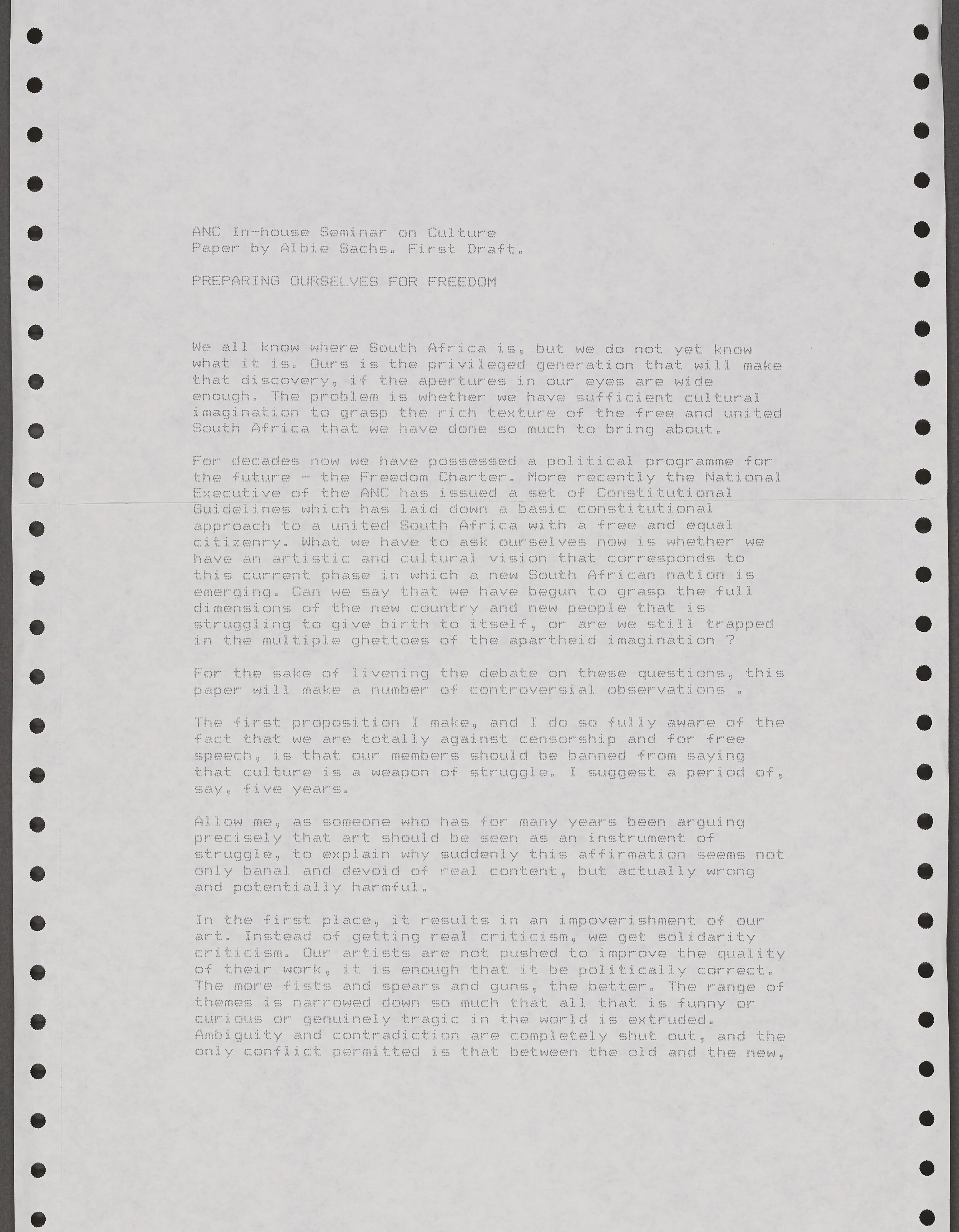
Albie Sachs, "Preparing Ourselves for Freedom," first draft, 1989, Courtesy The Albie Sachs Collection.
"Preparing Ourselves for Freedom" argued something almost heretical inside a liberation struggle: that culture was not a weapon to be deployed for the cause, but the foundation of a free and democratic society could not be built without. Sachs asked his comrades to imagine, in exile, under a ban, what kind of people they wanted to become on the other side of freedom, not just what political structures they wanted to win. He insisted on beauty, art, and love as legitimate political demands, not indulgences to be postponed until after victory.
At New Visions, this essay sits close to the center of what we do. Our work is built on a simple, difficult premise: that political imagination is not a luxury activists can attend to once more urgent problems are solved. It is the infrastructure democratic futures are built on, or fail to be built on, in the first place. Across the Middle East and North Africa, we work with organizations and activists confronting what Sachs called "the multiple ghettoes" of an unfree imagination, a condition in which political dictatorship is too often joined by a second one: the dictatorship of survival, so total that it becomes difficult even to pause and imagine anything beyond the present.
Our conversation with Justice Sachs, thirty-six years after he wrote that essay, is an attempt to bring its spirit closer to home. We spoke about freedom, art, democracy, and the ethics of love in movements, the ingredients we believe a political imagination needs if it wants to build futures worth wanting rather than just managing crises.
Sachs wrote his essay before he knew whether any of it would work, before Mandela was free, before the ANC was legal, before there was any evidence that joy was a defensible political position. Thirty-six years later, the region we work in has far less room for that wager, and far more reason to take it anyway. This conversation is our attempt to start preparing ourselves for freedom, again.
This conversation has been lightly edited for clarity and length.
New Visions: Albie Sachs, welcome to New Visions. Let me set the scene for our readers and listeners. It was 1989, Nelson Mandela still imprisoned, the ANC still banned, barely a year after you survived an assassination attempt in Maputo, while in exile, that took your arm and your eye. And yet, in the Spring Is Rebellious exhibit, you said you'd never enjoyed writing anything as much as this essay, in your own words, "it was cheeky, it was rebellious, it was defiant, and it was fun." How did something so joyful and playful coexist with everything you'd just survived, and with a freedom that was still so far from guaranteed? What gave you the audacity to write it?
Albie Sachs: It was a bomb that exploded, that took away my arm and sight in one eye. [But] I feel fantastic. They've come to kill me, I'm in the freedom struggle. You live all the time asking will they come for me? Will they come today? Will I get through? Will I survive? They tried to kill me, and they've only taken an arm. I feel joyous.

Newspaper article following the 1988 bombing, Courtesy The Albie Collection.
That was in 1988. It blew away all the little worries and concerns. This was big, this was huge, this was amazing, this was marvelous, this was magical! And I had to learn to sit up, learn to use a commode, learn to stand. Look, mommy, I can stand. It was like I was a little child again, learning to write with my left hand. Look, Mommy, I can write with my left. So that whole period of recovery, personally, for me, having been through that terrible, dark explosion. I didn't know what was happening, and coming out afterwards was joyous.

Albie recovering in London after the bomb, 1988. Photo courtesy The Albie Collection.
That was one aspect. The other was just a total presentiment that our country, we're going to make a breakthrough. Change is coming. One way I put it, all revolutions are impossible until they happen, then they're inevitable. We're between the impossible and inevitable. So internal, external, that sense of turbulence and change. And then the feeling: are we ready for it? We've almost got used to being in exile, in prison, in the underground. Are we open to freedom, to what freedom means? And that's where my experience of living in newly independent Mozambique was so vital.
Mozambique had been a Portuguese colony for hundreds of years before independence in 1975. I went to work there in 1977. And in 1988, I was blown up. The country shook me up in wonderful ways, because the Mozambican Revolution had a string of poetic elements. All the top leaders wrote poetry. It is part and parcel of expression. Partly, the intelligentsia in Portugal had been repressed under fascism. And they would meet in prison with the intelligentsia of Mozambique. And sharing [their] different modes of thinking and vision. And, you know, in the South African struggle, if Nelson Mandela wrote poetry, we would have been embarrassed. And if Oliver Tambo wrote poetry, we would have been embarrassed. That's okay, but, you know, we were used to total separation, in that sense, of the [cultural and] political minds. And then culture was often seen as a weapon of struggle. And it was a wonderful weapon of struggle. We would always sing. We would sing at funerals. We would sing at meetings. On Robben Island, people sang — they had wonderful choirs. That couldn't be taken away, even in prison. You would never just march. People would sing and march.
So in that sense, there was a lot of cultural expression inside the actual activities of the movement. But culture was seen as somehow separate. Culture was on the stage, you'd start with a cultural program, and then that would be over, and then you'd get to the politics.
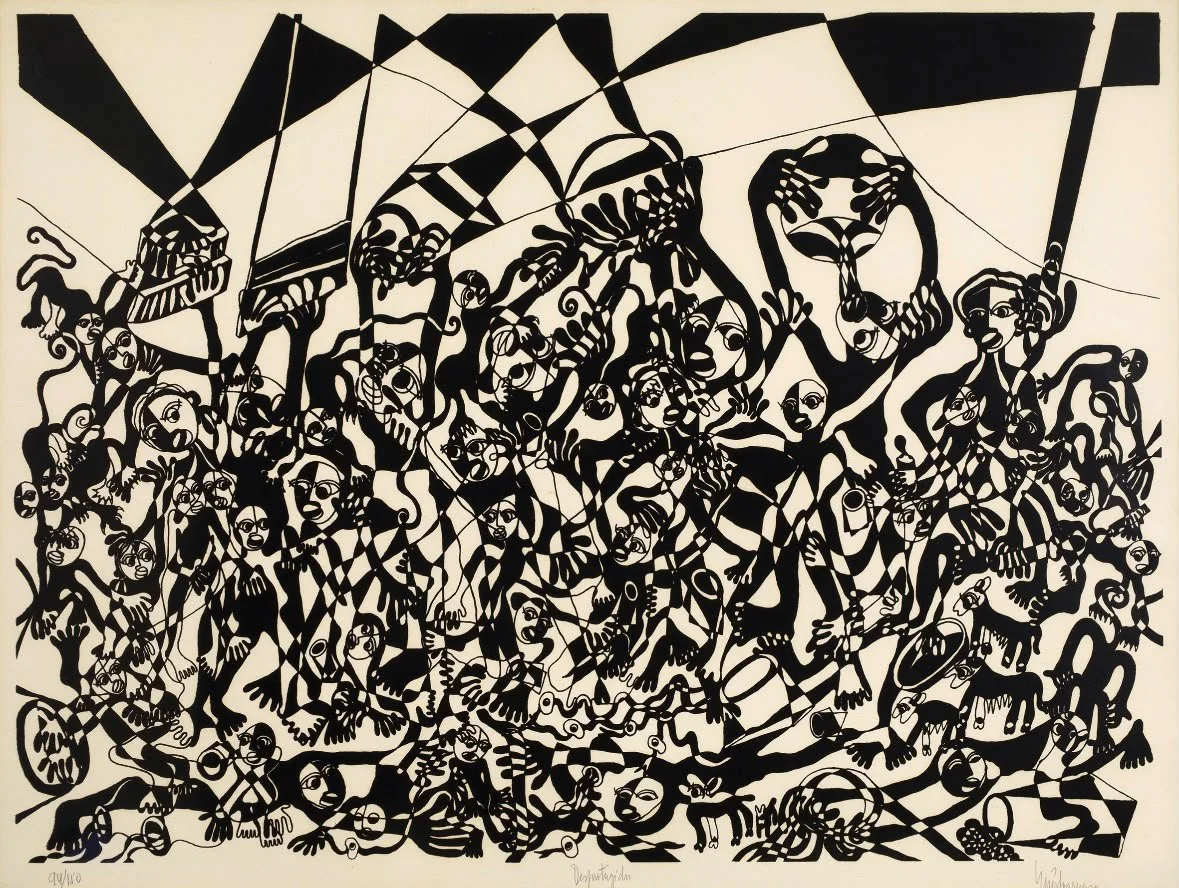
Luís Soares, Desprotegidos (The Unprotected Ones) 1978, courtesy The Albie Collection.
With Mozambique, it was much more integrated. President Samora Machel would sing. The audience would join in the singing all along the way. It wouldn't just be at the beginning and at the end. That was one aspect. The other aspect was the way culture in Mozambique helped to create a spirit of independence. They had so little in terms of materials; they had so much in terms of spirit. The Portuguese colonialists had established a mentality — [that] imagination was [reserved] for the small assimilated elite. And what the Mozambican government did and FRELIMO, the Front for the Liberation of Mozambique, did, was [ensure] every single school, hospital, university space, factory, public office would have a cultural group. That would be one thing. And then they would get images from Mozambican artists, Malangatana, the painter, [Alberto] Chissano, the sculptor, and many others and place them in their buildings.
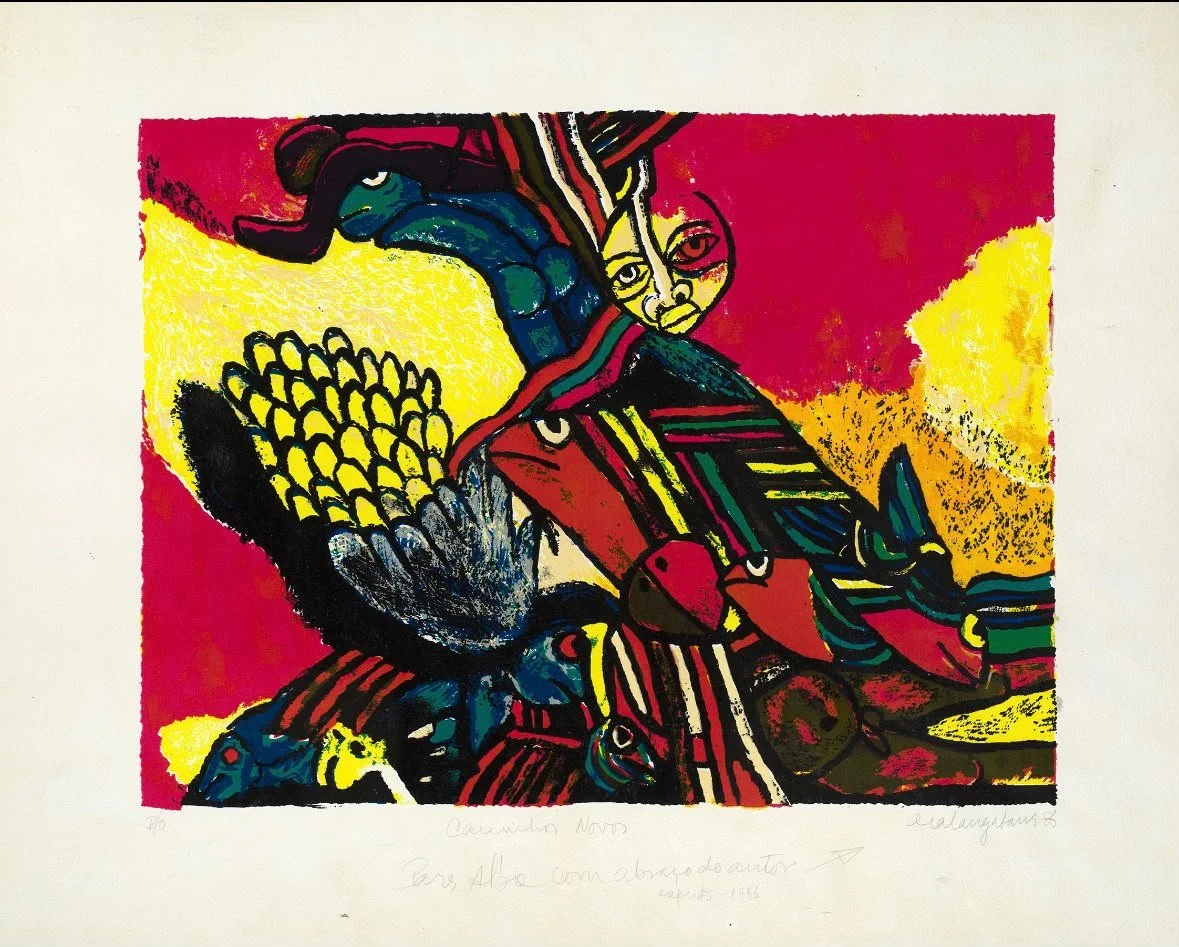
Malangatana Ngwenya, Caminhos Novos (New Ways), 1986, courtesy The Albie Collection.
So art was now helping what today we'd call decolonization not in a formal way, it was a natural, spontaneous way. And they didn't use the word "indigenize" or "Africanize." They used the phrase "Mozambicanize." That meant you're not excluding anyone, you're not destroying anything. You have people of diverse origins in the country, but overwhelmingly, the people were of African origin, speaking African languages, imbued with African culture in many ways, and that dimension would now express itself articulately.
The language of national unity was Portuguese — paradoxically, the language of the oppressor, but now the language of liberation, the language of unity, the language of poetry. One of their poets, Jorge Rebelo, came out with a wonderful phrase that was so relevant to our struggle. He said: "It's not enough that our cause be pure and just. Justice and purity must exist inside ourselves." So powerful.
These themes hit me in the face in a beautiful way when I was there. And there's the big murals movement, I helped to paint one mural myself. So that sense of art being part and parcel of the expression of a nation, not just the artists doing beautiful things, but everybody involved, through singing, through dancing, through painting, just became like second nature to me. And I began to feel dissatisfied with the cultural expression inside [our] liberation movement itself. For years, I'd been saying art is a weapon of struggle, artists must be involved in the struggle, and of course they must be.
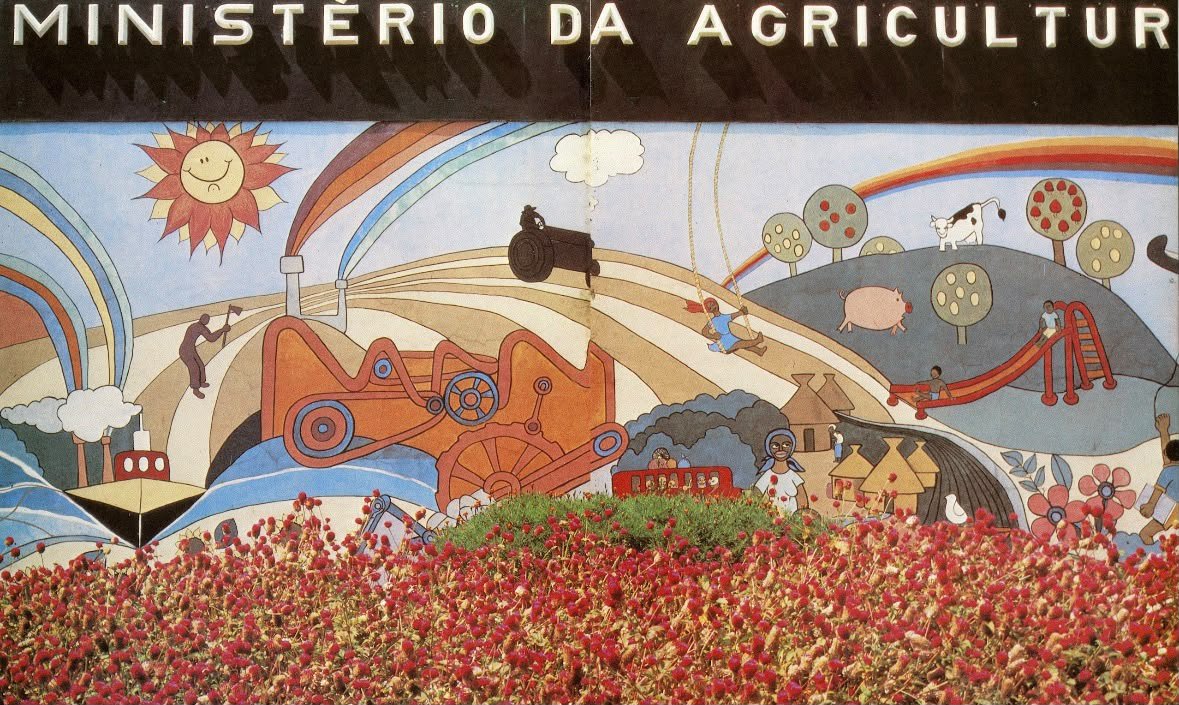
Ministry of Agriculture Mural, Maputo. Image from "Images of a Revolution" publication. Courtesy The Albie Collection.
New Visions: But then You urged your comrades, many of them also in exile or underground, in the middle of an armed struggle, to stop treating culture as a weapon of struggle, to let go of art that served a political line, and instead let it hold ambiguity, contradiction, even joy. That's a strange thing to ask of people fighting for their lives. Why did you believe that culture wasn't just useful to the struggle, but actually foundational to the democracy you were trying to build, that a free society couldn't be born without a free imagination first? And in your perspective, why is it important for activists to sit with ambiguity and contradictions?
Albie Sachs: Right, I didn't say stop using art for the struggle — carry on with art in the street. But don't reduce art simply to a weapon of struggle, because then you're simplifying it, and you're simplifying life that's [actually] very, very rich and profound. In fact, it's more political to go into the contradictions and the complexities. It's more profound. It's more unifying. So you're not just marching to a beat, to a drum, you also get a firmer connection with reality. I say look at our art and you can see who the heroes are. They're all, if they're men, handsome and strong and brave, and the women are all beautiful and strong. And you look at the enemy, and the enemy is ugly and stupid, and so on. In fact, life is much more complicated than that. There are problems inside our own movement too.There's sometimes even ugliness in the beauty. And you've got to start finding, in the enemy, the opposition, points of beauty, so that one day you can live together in one country.
So it's that kind of richness that I had encountered as a lived reality in Mozambique that I wanted to see in our own artistic representation. And the great Mozambican artists didn't go in for triumphalist art. They went in for art that was complex and harsh and painful, and I remember saying to Malangatana, the painter, one day: "Your colors are dark, your people are sad." And he said, "Albie, our people are traumatized. The trauma is deep. You can't just get away from that by painting rainbows, and joy, and things of that kind."
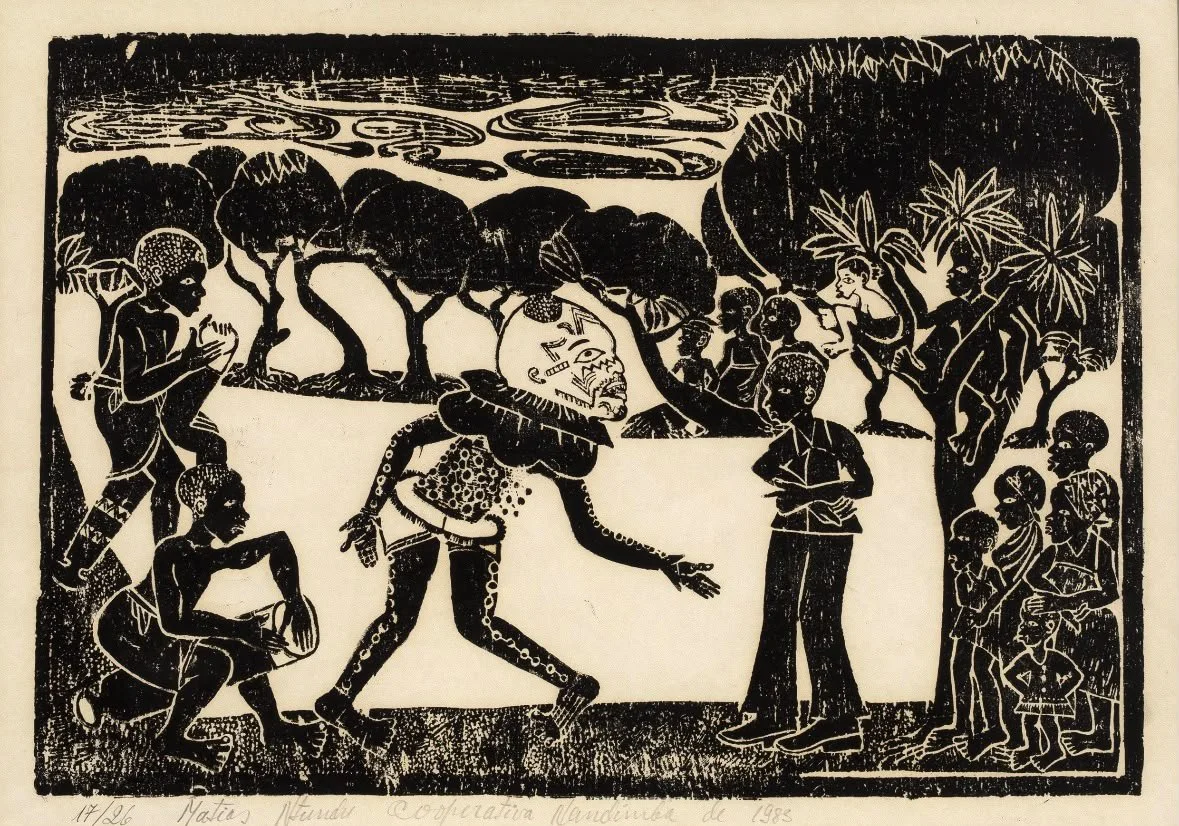
Matias Ntundu, Cooperativa Nandimba, 1983. Courtesy The Albie Collection.
And I was also sad that the richness of the lives we were experiencing, with humor, with laughter, with joy, with tragedy, with contradictions, somehow wasn't being captured in our paintings, in our poetry, in our novels, to nearly the great extent it should be. The one area where we got it was music. People like Abdullah Ibrahim, Miriam Makeba, Hugh Masekela. They, in music, created the kinds of sounds that were so rich and warm, sometimes fanciful and sometimes strident, sometimes deep and severe and very mournful, a full range of emotions, and that's really what we wanted.
New Visions: Reflecting on South African artists, especially the jazz pianist Abdullah Ibrahim, who passed away just this June, you wrote that when he played, you entered "a universe of wit and grace and vitality and intimacy," a "cop-free world," free of pass laws and racial domination. His music didn't just resist apartheid, it bypassed it, ignored it and overwhelmed it, asserting that another world already existed, long before it existed politically.
I think about this a lot when I see activists across the Middle East and North Africa today, burned out, depleted, betrayed by revolutions that didn't deliver. It's understandable, but it can also become a trap.
What would you say to them? Is reclaiming wit and joy, not letting yourself be defined only by your conditions, something necessary in the struggle for freedom ? Maybe even part of what freedom actually requires?
Albie Sachs: You know, Samora Machel, the president of Mozambique, he was a hospital nurse with four years schooling, brilliant mind. And he used to give public addresses, and we loved going there to hear him. And he used a phrase one day: "The enemy is camping in our heads." And I felt so often we were allowing the enemy to camp in our heads, to define who we are, what we're doing, what we're imagining. And that's what I found so wonderful about our musicians. There was a joy and energy and independence, a creativity, a daring, an adventure, that was wonderful. It was ours.
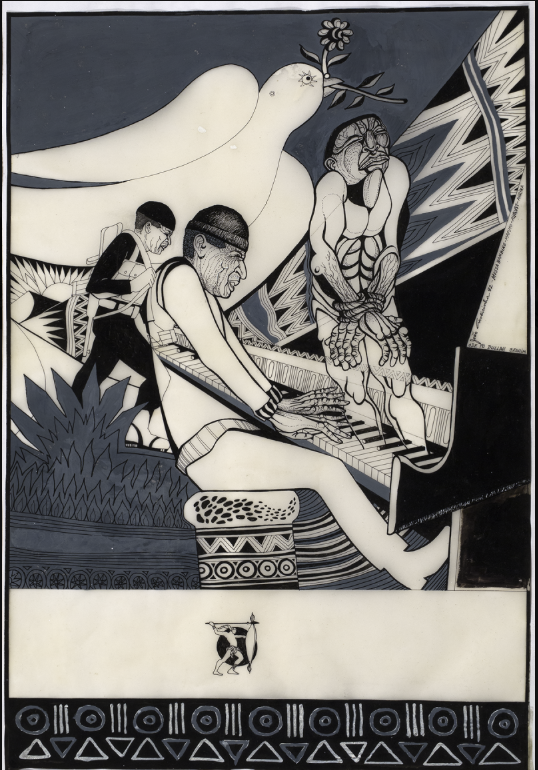
João Craveirinha, Ode to Abdullah Ibrahim, Freedom Concert, 1982 Courtesy The Albie Collection.
It came from indigenous music, church music, traditional music, jazz, even bits of classical music coming into it in different ways, but extremely expressive. And it wasn't the lyrics so much, it was the energy, the vitality of the sounds. It was uplifting.
It energized us and it enhanced our sense of humanity and gave us courage in that way. You get courage from bugles and from drums, and that's okay. But if that's all you're hearing, it gets a little bit boring. So you want that variety, the variety that life has, that you experience in life. And I was getting that from Mozambique, coupled with the magic and the mystery of surviving the bomb. It gave me the courage to be daring. In those days, the worst thing that could happen to you was to be called bourgeois, particularly if you were bourgeois. I mean, for middle class, I was a lawyer. And now, you can call me bourgeois, I don't care, I am having fun, I am writing this paper, and it's just great for me. And I sent it off. I didn't even attend that conference. It was a long way to fly. And I forgot about it, and I thought it'd be over, you know, you produce something and people don't read it. I [myself] often don't read documents. This was before internet in those days. And I heard about two months afterwards from somebody who'd been there, who said, " Comrade Albie, your paper tore the conference in half." They were fighting over it, and some were saying, "How can he say we must stop saying art is a weapon of struggle." And the other was saying, "Yes, I feel liberated."
When I got back to South Africa, just to make the point, one of my books, The Soft Vengeance of a Freedom Fighter, was launched at the University of Cape Town.

Albie Sachs, The Soft Vengeance of a Freedom Fighter, 1990, cover image. Courtesy The Albie Collection.
I'm sitting down and I feel fingers over my eyes, and I hear a woman's voice, and she says, "Guess who, Albie? I used to love tap dancing. Then I joined the struggle, and I felt tap dancing is imperialist and bourgeois, and I shouldn't do it. Then I read your essay, and I went out and I did a tap dance. And now my vision is going to an ANC conference and jumping out of a cake." And then I knew straight away that I was right. If people can't tap dance anymore, if people love dancing but feel it's not political [enough], there's something wrong. There's something wrong.
New Visions: So for you, we really need to reclaim our sense of joy as part of our fight for freedom, right?
Albie Sachs: Yes. Yes.
New Visions: So it's not indulgent. It's basically a necessity for resistance.
Albie Sachs: Yes, and yes. There's a problem there, because you can't manufacture joy. You can't express joy as a political duty and responsibility. It's something you've got to find inside yourself and release. So maybe that's what I was really calling for, not a new ideological position, "thou shalt have joy, you must be joyous, because that will help the struggle." It's changing the imagination in a way that allows the joy to come out, allows the danger, the risk, the contradictions, the examination, [to be expressed].
We had many problems in our struggle. There were times when I felt so disheartened by conduct that was really abusive, incorrect, dishonest. But I always felt our leadership was good, was right. The whole is better than the parts. And I felt we must be honest enough and strong enough to examine these problems, our own weaknesses and failures, not simply from a didactic revolutionary theory point of view, but from a human being expression point of view. And so I felt very joyous writing that paper, and I couldn't find enough words to say that once I opened up, I had to open up my own imagination, and once it happened, the words just flowed.
New Visions: I can assure you that thirty-six years later we still can feel the joy. I felt the joy even before knowing the full story behind that essay. But it was also rebellious.
Albie Sachs: Yes.
New Visions: In the essay, you ask something unexpected for a movement document , "what about love?" You write: "What are we fighting for if not the right to express our humanity in all its forms, including our sense of fun and capacity for love and tenderness and our appreciation of beauty?"
New Visions, our organization, is actually named after bell hooks's book All About Love: New Visions. Hooks argued that love isn't just a feeling but a discipline, built on care, knowledge, commitment, trust, and respect and that movements built only on anger or resistance, without that ethic at their center, eventually become as harsh as what they're fighting against.
It strikes me that you were reaching for something very close to that, in 1989, from exile, inside an armed liberation struggle. Why did you feel the need to insist on love as a legitimate political demand, not just a personal indulgence? And do you think today's movements have lost that thread?
Albie Sachs: I felt these things intuitively, inside myself, having survived that attempt at blotting me out, killing me, and got through. It was miraculous, and fantastic, and marvelous. So that joy was inside me. I [also] felt the joy of our struggle, that we're now going to be going home and coming out of prison and bringing about change. So all of that produced a beautiful energy. And maybe that evokes the joy and pleasure I'd gotten out of reading novels, seeing wonderful films, attending opera [earlier in my life].
It is something exalting and beautiful and uplifting. And part of our struggle against oppression then was to have the right to beauty. It wasn't even that beauty makes us stronger and we'll defeat the enemy. It was a demand, we had to be full human beings. That's what we were fighting for. And then I sensed it had a wider ramification, because if power, control, destroying the enemy is all you're doing, you are narrowing your vision. You're closing your heart down. You're restricting yourself. You're not expressing yourself in all your humanity. And there is so much beauty in the struggle, courageous beauty, human comradeship, beautiful relationships, dreams, imaginations. You know, beauty was trying to come out, not to be suppressed. And I would say, by and large, one of the strengths of South Africa today is that that craving for beauty, and expression of beauty, and encounters of beauty, and relation of beauty, hasn't gone away in our country. People are facing great hardships in many, many spheres, and lots of unacceptable bad things have happened, from people who've been former revolutionaries and great freedom fighters. But people are not downtrodden. They speak art in different ways. And I'm always gratified that our biggest growth industry is stand-up comedians. Trevor Noah is the famous one, but it's all over the country. So again, it's that ability to laugh at yourself, to open up, not to become trapped in narrow definitional living. We don't live by definitions. We live by expression. Definitions help us and are useful, but they shouldn't dominate us, they shouldn't imprison [us].
New Visions: Let's talk now about the moment of liberation. After apartheid, you were appointed by Nelson Mandela as a judge on the new Constitutional Court, and once there, you did something no one expected of a judge: you began curating, commissioning, and bringing art into the court building itself. You asked something most judges never would: "What if justice was not only fair, but also beautiful?" And you've argued plainly that art and intellectual expression aren't peripheral to building free, democratic societies, but central to it.
I keep thinking about what that actually required of you, not the principle, but the fight. Was there a moment someone told you this was frivolous, a waste of energy better spent elsewhere, and how did you answer them?
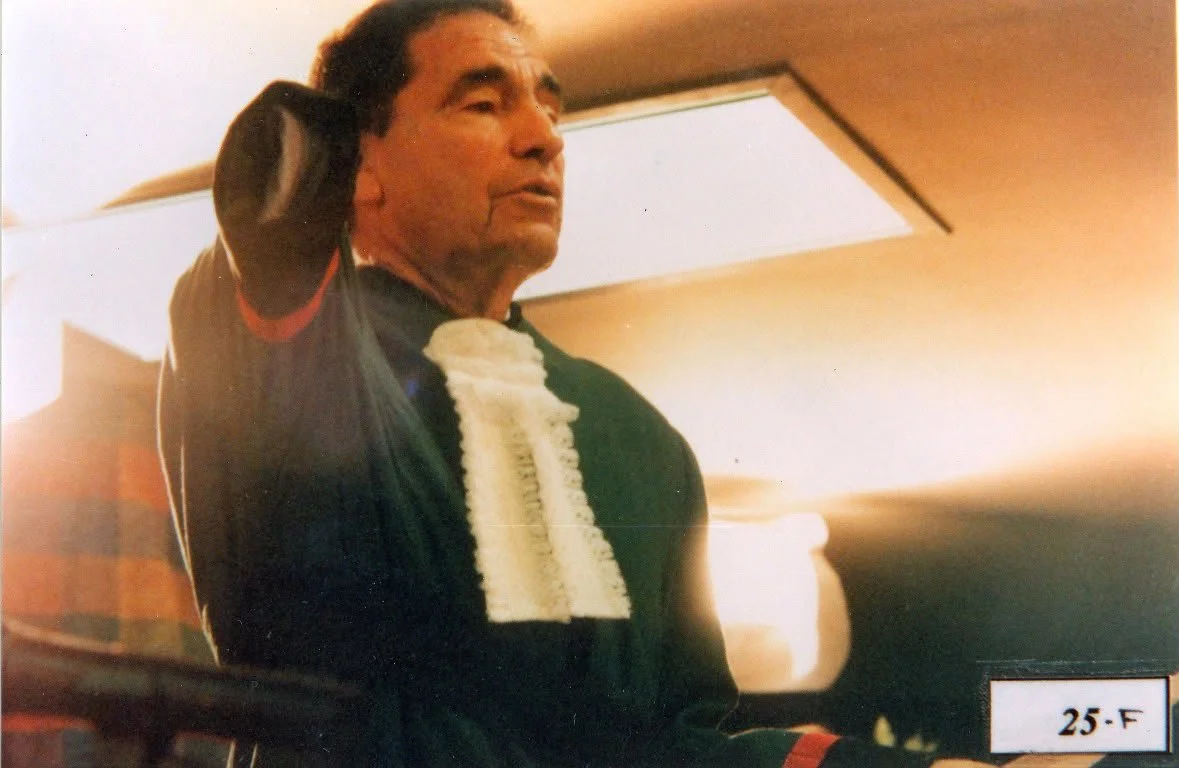
Albie Sachs as he is sworn in as a Justice of the Constitutional Court of South Africa. Photo courtesy of The Albie Collection.
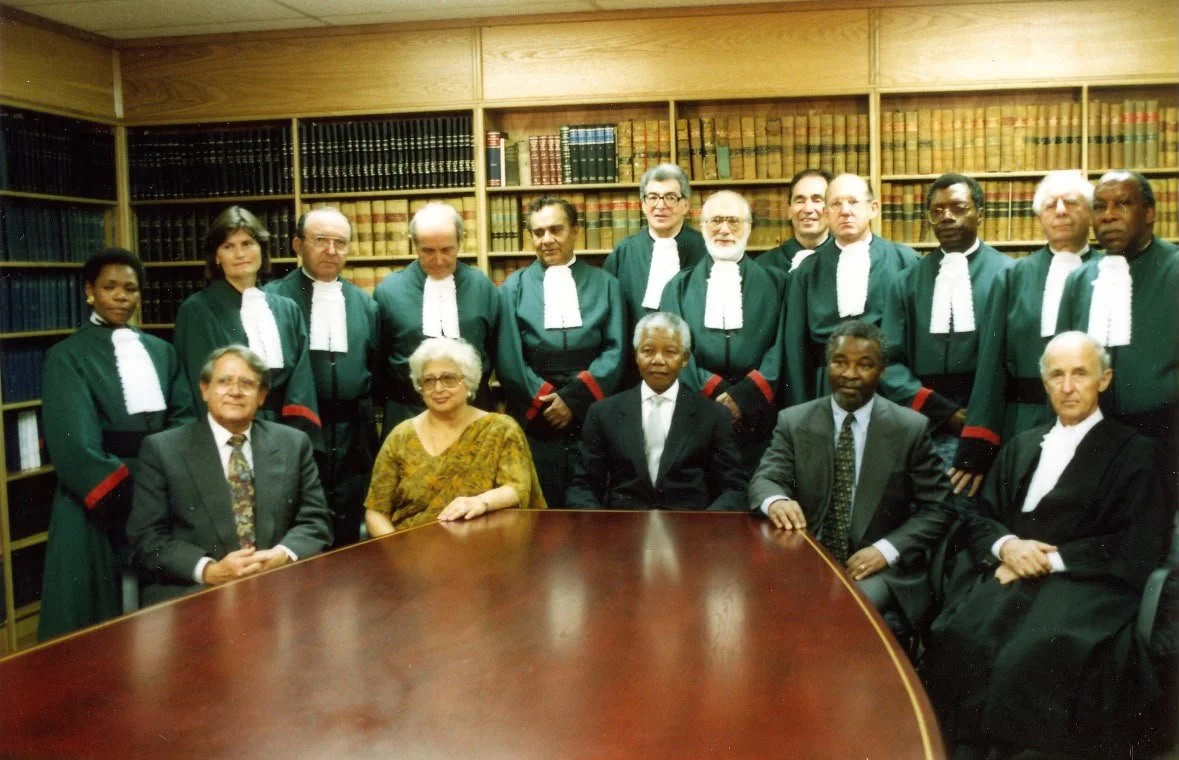
Formal picture of the original Judges of the new Constitutional Court, on inauguration day 1995. Photo courtesy of The Albie Collection.
Albie Sachs: Well, the way the question was put, not quite as dramatic as you're putting it - I prefer your question, but that's not the question I got. The question I got is, how can you spend money on art when so many people don't have a roof over their heads, so many people don't have food? And my answer. came immediately to me. Are you saying poor people only want a roof over their heads and food to eat? That poor people don't have a right to beauty? This is in a public place, a public space where your fundamental rights in your Bill of Rights, are being affirmed. And you have a right to be in a building that's not frightening, that's not representing the power of the state, a building that will say [Welcome, Mama. Welcome, Papa.]
The head of the Commission for Gender Equality was on the jury for an international competition we had for the best building for our new South Africa, for our first Constitutional Court. And we placed that building in the middle of an old prison. That's a beautiful act. It's a symbolic act in itself, turning negative energy into positive energy. It was part and parcel of the very construction of the place [that was] deciding the fundamental rights of human beings.
And Thenjiwe Mtintso, who had actually been a commander in Umkhonto we Sizwe, the armed wing of the ANC. was on the jury. And she said, "Why did you put me on the jury? You saw there were only men." And she was absolutely right. And she immediately took command. And she said, "I'm my mother. My mother is frightened of modern buildings. My mother wants to go around the back, with a piece of paper, and ask, can you take me to this office? I want a building that's smiling, that's saying, Mama, come into this building, you are welcome, it's your fundamental right. And that's the one I want." And she pointed to design number 62, and the theme was justice under a tree, the traditional way of resolving disputes in Africa, with everybody taking part. And it was the most beautiful design. The editor of the British Architectural Review said it's the best jury he's ever been on, because normally the professionals fight, and the lay people go for the least exciting entry. And this time, the lay people went for the most exciting entry, and she'd been a prisoner in that prison herself, in the women's jail. And she said, "That's the one I want."
Video footage of the Constitutional Court of South Africa building. Excerpt courtesy The Albie Collection Compendium of Judgments - see www.thealbiecollection.org
So we started off then with a big, beautiful building that was welcoming, inside and outside. What frightens me, if I go into the lowest court [in the land], is that I feel guilty, and I'm a judge. The architecture says, we know what you've done, we are onto you. And we built this for Thenji Mtintso’s mother, a mother who had taken in washing from other families to send her daughter to school and university, who then joined the liberation struggle.
Then, for the art [in the Court], we got away from the imported symbol of the blindfolded woman with the scales of justice. We got a [new] logo instead. It all started with a little logo: a big tree, with people under the tree. You can get a copy of it to show [to] your viewers.
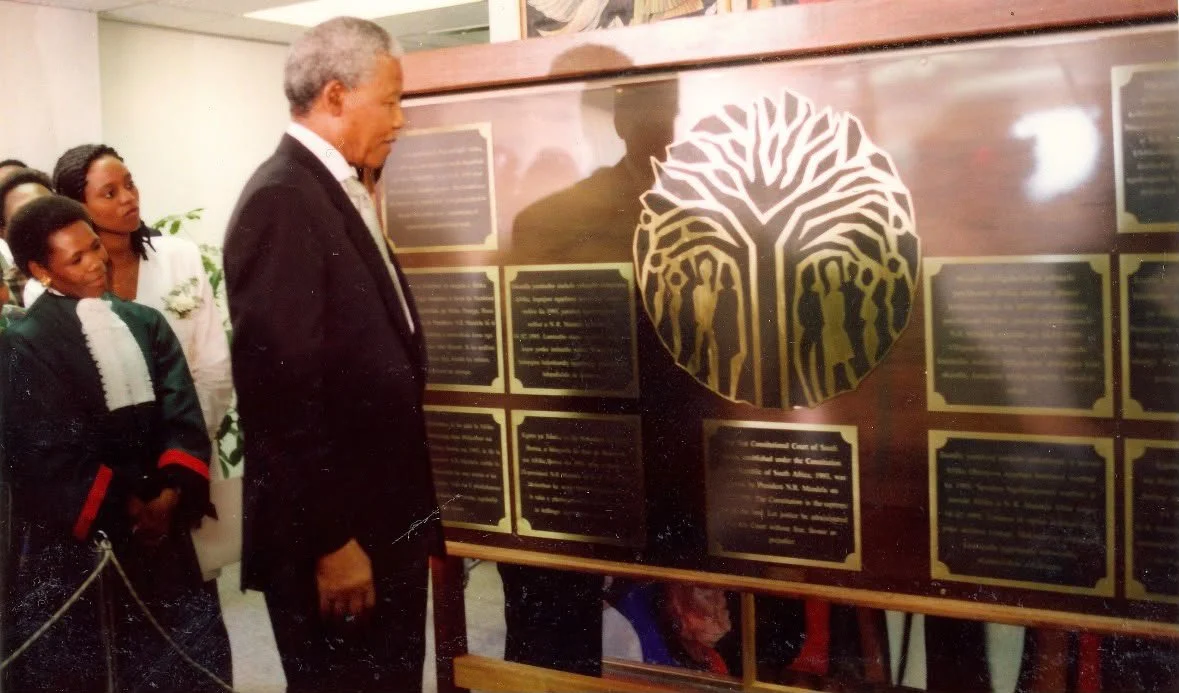
President Nelson Mandela unveils the new Constitutional Court logo in 1995. Photo courtesy of The Albie Collection.
It's a change of imagination. Then we were given the equivalent of two thousand U.S. dollars for décor. Today I take people around and say, look what you can do with two thousand dollars, you just have to be a little mad. The architects have to be a little mad, the judges must be willing to go along with the madness, and the times in the country must call for that madness.
And this is what you can do. It's now become part and parcel of the project. It doesn't make us wiser [as judges]. I wouldn't say our decisions got better when we moved from very simple office accommodation into this beautiful new building. But it reinforced the idea of fundamental rights being at the heart of the project. It's about people, law is about people. You don't force people to fit into categories. We create categories to enable people to be themselves and to express their humanity [to the fullest].
And in that sense, the artwork, we didn't go for abstract art, because I didn't want to encourage the idea of law being pure rationality. Law's not just rationality, it has to be rational, it has to be disciplined, it has to be organized, it must have methodology. But that's not all it is. Law is about the rights of human beings and people. It must have a heart as well as a mind.
And so all the initial art that we received, that we acquired, I'd open an exhibition and tell the artists, other artists gave us wonderful work, can you do the same? And they [would] ask me to select something. They felt very honored that their work could be at the court. So we built up a very beautiful connection. And some of it features at the exhibition now at the Zeitz Museum of Contemporary Art Africa.
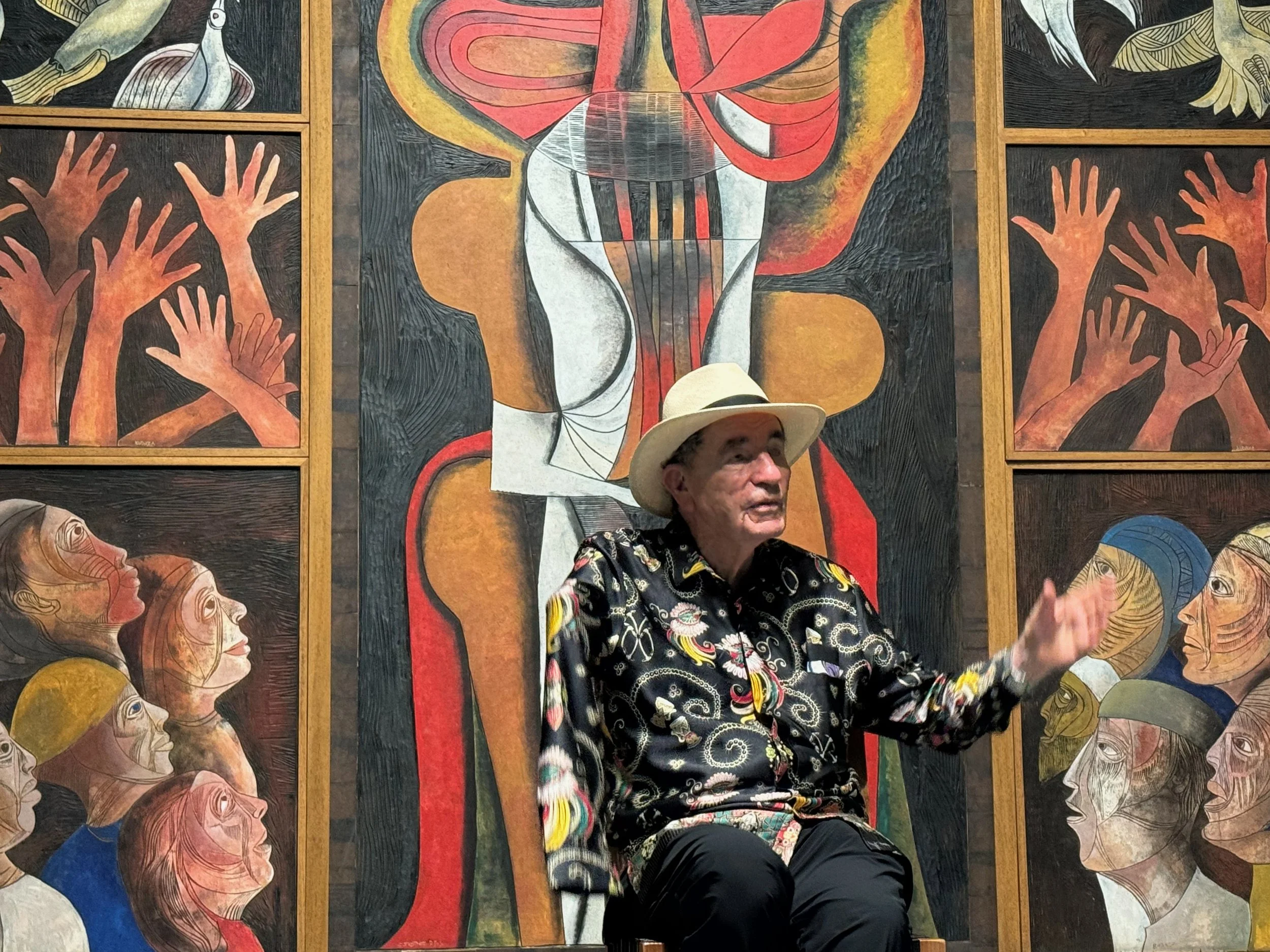
Albie giving a walkabout tour of Spring is Rebellious: The Art & Life of Albie Sachs exhibition at Zeitz Museum of Contemporary Art Africa. Photo courtesy Carolyn Parton / The Albie Collection.
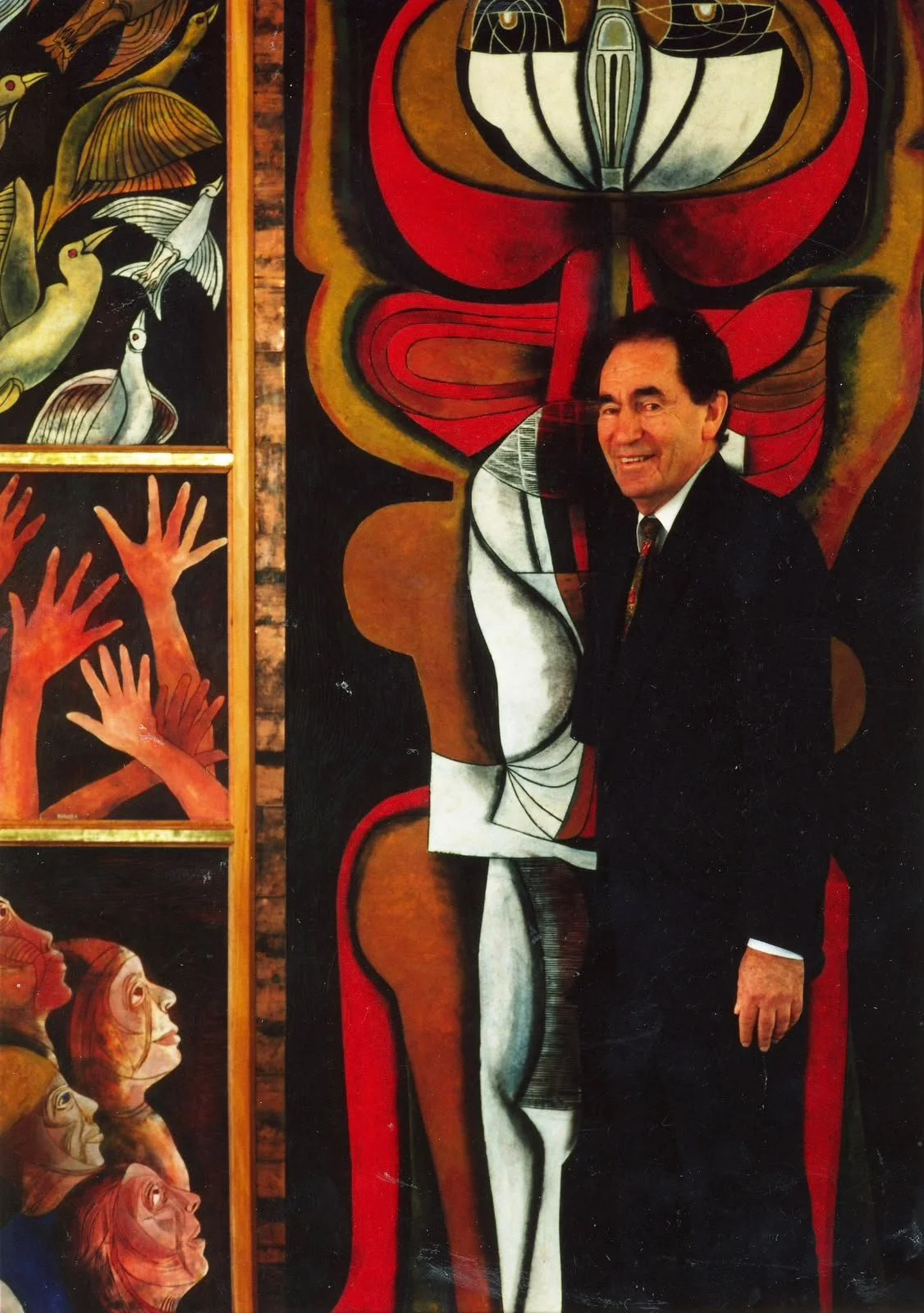
Albie Sachs in front of the artwork by Cecil Skotnes and Hamilton Budaza. Photo courtesy of The Albie Collection.
Africa is a very important part of it. And it's not just the traditional African art that's quite well known in exhibitions, you have Egyptian art, and African art that would usually be in dark wood, maybe some bronze, from the past. It's very expressive art of people today, many women artists working in different media, and a wonderful place and space to be, an old granary converted into an art museum at the waterfront in Cape Town.
New Visions: Yes. Yeah, indeed, it's a very beautiful space. But you know in much of the Arab world we don't have that fight yet. We're still trying to win independent courts at all, let alone beautiful ones. So I want to ask you something almost selfish: was beauty a luxury you could only afford because the political victory had already been won, the constitution written, the court established, or was insisting on beauty actually part of how you won it?
Albie Sachs: It's definitely part of how we won it, the emotion, the thrust, the energy. It wasn't an adornment. It wasn't saying, we've got our freedom, we've got our constitution, now we need a pretty building to show how splendid we are. It's almost the inversion of that. The building, in many ways, it's a very [awkward] building, it's not symmetrical, it's not rational, it's got different locations and spaces, using modern materials, modern thematics, to express ancient emotions and dreams. I get a lift when I go there, I've been off the Constitutional Court for fifteen years or so, it's quite a long time. It's just something the architects found, the conjunction of light, place, space, vision, function. It's very modern, and yet it's very warm.

Albie in the Constitutional Court foyer, 2025. Photo courtesy Carolyn Parton / The Albie Collection.
New Visions: In South Africa, resistance gave way to a long negotiated transition, then to liberation, then to the slow work of building a democracy that, however imperfectly, has held. In much of the Arab world, we've seen something different: real resistance, a small window of genuine liberation through the revolutions, followed by a societal divide between Islamists and secularists, then a return to authoritarianism, or in other contexts, a civil war.
What do you think actually has to happen inside resistance itself to prepare for that liberation window, and then what does it take to carry the liberation moment into real transformation, rather than letting it become just a pause before collapse?
Albie Sachs: I should be asking you that question. We hated outside people telling us how we should conduct our freedom struggle. But just thinking back to the way you're projecting it, I happened to be in Tahrir Square in Egypt, not long after the uprising there. It was a marvelous moment. I could feel the joy and the excitement. And then not long afterwards, everything seemed to be vanishing. And clearly the tension between the secular and the religious was utilized by people who wanted to restore what had existed before. And maybe in that sense, the conjunction of the religious and the secular in our struggle turned out to be very, very helpful. Oliver Tambo was the leader, the law partner and leader in exile of the ANC while Mandela was in prison. He'd been Mandela’s law partner before. He was deeply religious. He was going to be ordained as an Anglican religious leader in December 1956, and marry his wife Adelaide. Instead he was arrested, thrown into the very prison where we built our court today. Set up a choir, became leader in exile.

Oliver Tambo's Dream, cover image, 2017, Courtesy The Albie Collection.
I grew up in a very secular family. My parents had fought their parents on religion. In any event, years later, Oliver Tambo was invited to speak at a world conference on religion. He came to me for advice on his speech. He felt that I would find the words. And I just had huge love and respect for him, although we had a totally different matrix, if you like, formal matrix of belief systems, there's a core that bound us together. He would express it in terms of his religious beliefs and Jesus, and I would express it in terms of revolutionary love, if you like. But we came together.
Later, when it came to creating the Constitution, the religious people wanted to say, in humble submission to Almighty God, at the beginning. That would be very oppressive to secular people [starting with those words]. So I came up with what became the solution - Nkosi Sikelel' iAfrika, God Bless Africa, that was our freedom song that we'd sung in prison. And I'm secular, and I would sing it with my right arm raised with a clenched fist. So I think that was one very important theme, that we didn't allow the enemies of our struggle to divide the movement between the secular and the sacred.
When [afterwards] it came even to my work as a judge, and the question of same-sex marriages cropped up, I don't think it's something on the front of your agenda now in the Arab world, but we had to face up to it. And I said, instead of speaking about the clash between the sacred and the secular, we [should discuss] about the coexistence of the two. The sacred exists in its sphere, and the secular doesn't trash and suppress the sacred. But the sacred can't impose its values on everybody, including those who don't belong to a particular faith. And on that basis, as you know, we allowed same-sex marriages, acknowledging the love that people have for persons of the same gender, without compelling religious people to perform ceremonies that go against their faith. That has meant that today there's a majority of people in South Africa who accept the rights of same-sex couples to be married and to express their love in that way.
New Visions: Well, I remember when the Tunisian Revolution happened. We spent three years drafting our new constitution, and it was quite an inclusive process. There was a lot of political debate, and there were many progressive laws, especially on gender equality and women's rights, but at the same time, there was a lot of tension. I think because we lived for many years under a dictatorship, we also inherited the dictatorship mindset. We did not know how to manage political confrontation, or how to manage division within the political space. Every side wanted to exclude the other side. We couldn't imagine a society that could hold everyone, and that politics, political parties, could be the space where we debate those ideas.
Those were very, very tough years, especially for people like me, who really believe in coexistence, and in using the constitution and the political space to defend our views. And I think, honestly, part of the setback we are living today is our incapacity to manage that difference. Partly because we lived under dictatorship, we really didn't know how to manage freedom.
This brings me to my final note. For people like me, and for us in the Middle East and North Africa, who lived through that collapse, I marched in the Tunisian Revolution. I always say that was the happiest day of my life, and I truly mean it. And then watching the collapse again can be a little bit depressing. What would be your advice to us, to come back and start preparing ourselves for freedom again?
Albie Sachs: Okay, the usual advice I give is: don't listen to the advice of old people like me; be as cheeky, irreverent, challenging as I was when I was young.
But that's not satisfactory. First of all, you have to learn the lessons of victory, and then the lessons of setbacks. Secondly, you have to be proud of what you did achieve and not dismiss it. It was huge. It was wonderful. It inspired the whole world. It inspired neighboring countries. So that's something indestructible. You did do it. It was real, it seemed impossible, and yet it became very, very powerful. And Tunisia was put on the map, as a country that was the source of courage for so many others.
Then, I think clearly of the theme of unity, which I haven't spoken about so much now. I think that's where our leaders, like Oliver Tambo and Nelson Mandela, were particularly adept. [They weren’t] saying, follow me, I have the answer, I incarnate everything you're struggling for. In fact, they would always be the last to speak at meetings. They would listen to others. That's in the African tradition. And listening to so many people who agree on certain core themes, to rally around that, and to work together. That was where we in South Africa, I think, did better than maybe any other liberation movement in the world.
I used to meet in London. London is a place of exiles from all over the world. Very many from Latin America, the military dictatorships, but also from Asia, from Africa, even from America, victims of McCarthy living in London. And almost all the movements were splintered. They fought amongst themselves. Each one said, I am the true leader of the opposition. And we [in the ANC] did have breakaways, we weren't the only movement. But we didn't have public fights. And we had a clear vision, clear goals, and we rallied around that. And that became important inside South Africa itself, to give the white population a feeling that there is a place for you in the new country. It's not life or death. It's not conquer or be conquered. There is an honored, dignified place for you, but only on the basis of equality. And you will get that, because we all want that. That's the country we want to live in.
And there must be equivalents for your own countries. You know, we suffer from corruption now. I'm sure there were people in your movement who were very brave, very wonderful, and they ended up in office, maybe gathering for themselves. That experience, some of the greatest of people, ended up with power just messing with their minds. New opportunities to get involved, get wealth and prestige and authority through your position in the state, can be very debilitating. Anyway, so it's [now a question of] coming together, finding common platforms.
To end, maybe where we began. A richness of mind, an imaginative approach, enjoyment of life, enjoyment of the solidarity and the companionship, and looking for positives, even in the opposition, in the regime. And looking for ways that don’t convert every struggle into an existential battle, for the one to live, the other must die. So it's unity in your ranks on the one hand, and space for the opposition, to encourage the opposition not to dig in their heels, not to raise guns every time you demand anything, and saying [to them] that there'll be a place for you. That was vital in what became, in the end, a peaceful revolution. And our Constitution has held. It's not just a text, institutions sustain it. Our court has played a very, very big role, and the press plays a big role, civil society has been exceptionally important, and we have a very lively political scene. So even although there are awful things happening, we know about them happening because of the press, because of civil society, because our people speak out. And our people are able to respond with culture, culture not being simply a weapon of escape from reality, a weapon of dreams that's outside the real world, but culture as a mode of expression of ourselves, in all the diversity and variety and incongruity that we have as human beings. Let that come out, and it gives you a bounce in life. It gives you a sense of hope, even when things are not looking good.
New Visions: Fantastic! Well, thank you very much, Albie Sachs. I am so grateful to you for your generosity and your time. That essay has really inspired me very, very much, and this is why we are having this conversation. I hope it will inspire many other people, like it did in the past.
I consider myself someone preparing myself for freedom too. I might live to see that day, I might not. But I think what I learned from your essay is that while I am on that path, I am already free. I am a free thinker. I can still shake things, move things, propose things. What I still need to learn is how to do it with joy, wit, and grace, because sometimes those fights are very hard, and we are impatient to see results. But it is so liberating to know that the moment you are on the path for freedom, you are already free, that you are not defined by the oppressors, and that you can still build something else despite everything.
So I really want to thank you for your time and for your generosity. It has been the honor of my life, having this conversation with you.
Albie Sachs: And you're making me feel young again. Yay.
New Visions: Well, that's amazing. Did you find it sparkly, as we promised you?
Albie Sachs: Absolutely.
New Visions: Thank you. Thank you so much.
End Of The Conversation
[1] Albie Sachs, "Preparing Ourselves for Freedom," 1989
[2] Spring Is Rebellious: The Art and Life of Albie Sachs, curated by Dr. Phokeng Setai, Zeitz Museum of Contemporary Art Africa (Zeitz MOCAA), Cape Town, July 24, 2025–August 23, 2026.
